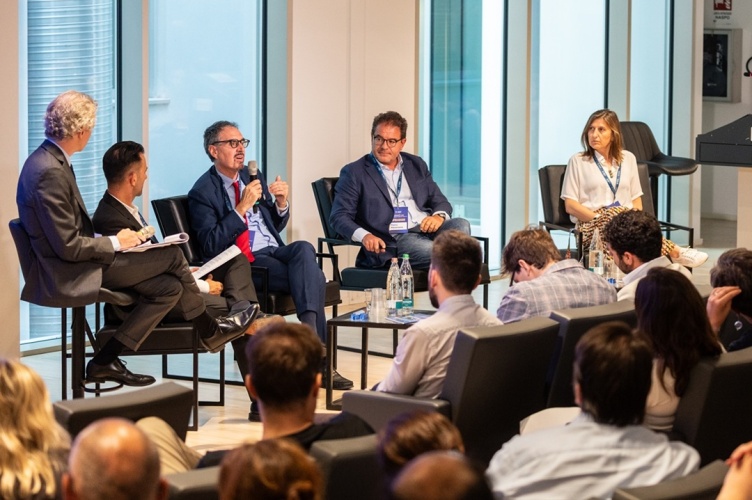
Connect Lab 2026 brought together executives, academics and governance experts at ESCP Business School in Turin to discuss the implications for business leadership and board decision-making
What does effective corporate governance look like when geopolitical tensions, technological competition and economic uncertainty increasingly influence business decisions?
This question was at the centre of Connect Lab 2026, held on 8 June at ESCP Business School in Turin. The annual event brought together executives, academics and institutional representatives to discuss how organisations are adapting to a business environment where geopolitical developments are no longer distant issues, but factors that directly affect strategy, investment and operations.
The event opened with remarks from Alberta Di Giuli, Professor of Finance and Dean of ESCP Business School Turin.
“We are living in a moment when geopolitics is no longer a backdrop to business activity; it has become the operating context for companies in both international and domestic markets. Boards of directors are being called upon to evolve from oversight bodies into active strategic actors. At ESCP, we educate leaders capable of navigating this complexity with analytical rigour, cultural openness and a strong sense of responsibility. This is at the heart of our European mission.”
Understanding geopolitical change: a conversation with Francesco Costa
The first session featured a conversation between Francesco Costa, journalist and Editor-in-Chief of Il Post, and Professor Silvia Dalla Fontana.
The discussion focused on developments shaping the international landscape, from shifting political alliances and trade relations to the growing importance of technological sovereignty. Rather than treating uncertainty as a temporary condition, the conversation explored how businesses are learning to operate in an environment where volatility has become a constant feature.
The speakers also reflected on the growing relevance of geopolitical analysis for organisations and leaders, particularly as international developments increasingly influence markets, investment decisions and long-term planning.
How companies are responding to geopolitical uncertainty
The second session brought together professionals working at the intersection of governance, risk, finance and technology.
Moderated by David Vannier, Founding Partner of Georgetown Advisory and former executive at both the International Monetary Fund (IMF) and the World Bank Group (WBG), the panel featured:
- Luca Galli, Risk Leader, EY Italy Financial Services Organisation
- Marina Geymonat, Head of AI Lab, Leonardo Corporate
- Pietro Maranzana, Group Chief Financial Officer, TeamSystem
- Rocco Minà, Managing Director, Wabtec Italia
Drawing on experience across consulting, manufacturing, technology and financial management, the speakers discussed the practical implications of geopolitical developments for organisations.
Topics included risk management, artificial intelligence, supply chains, investment decisions and the growing responsibilities of boards when assessing long-term business choices. While perspectives varied across sectors, the discussion highlighted a common challenge: organisations are increasingly required to make strategic decisions in environments that are both highly interconnected and difficult to predict.
Closing the event, Professor Daniele Battaglia drew together the key themes that emerged throughout the afternoon, highlighting how geopolitical developments are becoming an increasingly important consideration for business leaders and boards alike.
Connect Lab
Connect Lab is ESCP Business School’s annual public engagement initiative in Turin. Each year, it brings together representatives from business, academia and institutions to discuss issues affecting organisations and the wider economy.
The 2026 edition focused on the relationship between geopolitics and corporate governance, examining how boards and executives can respond to a business environment characterised by uncertainty, technological change and increasing global interdependence.
From discussion to executive learning
Many of the questions raised during Connect Lab continue to shape the work of ESCP Executive Education.
The themes discussed during Connect Lab are also explored through the ESCP Observatory on Geopolitics and Governance, published with Il Sole 24 Ore. Through articles, analysis and expert contributions, the Observatory examines how governance practices are evolving in response to economic, technological and geopolitical change. The initiative provides a platform for ongoing discussion between academia, business leaders and governance professionals, extending many of the conversations that emerged during this year's event.
Through initiatives such as the Impact Talks, ESCP creates opportunities for executives, academics and industry experts to exchange perspectives on the issues influencing management today. These conversations complement executive and customised programmes designed to help organisations strengthen leadership capabilities and respond to strategic, technological and organisational change.
The School is also expanding its activities in governance and public leadership through the development of the future ESCP School of Governance, reinforcing its commitment to preparing leaders for an increasingly complex international environment.
Looking ahead
The discussions at Connect Lab 2026 highlighted a reality that many organisations are already experiencing: geopolitical developments increasingly influence strategic business decisions. Through initiatives such as Connect Lab, the ESCP Observatory on Corporate Governance and its Executive Education activities, ESCP continues to contribute to the conversation around how boards and business leaders can respond to a rapidly evolving global environment.
Campuses