
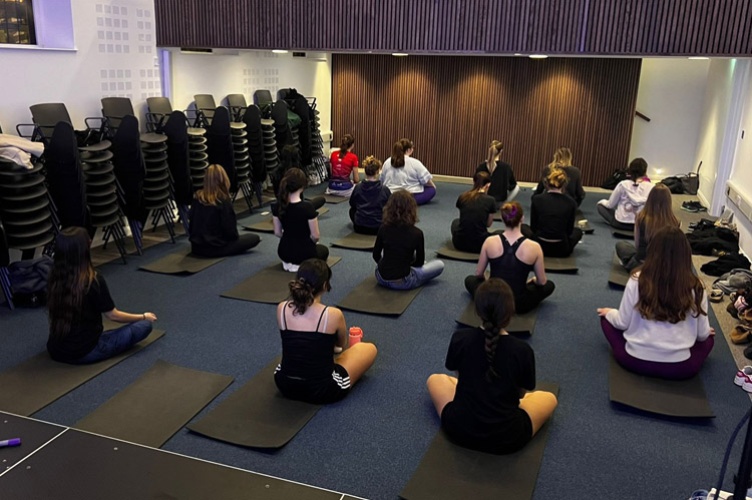
This February, the student union AGORA coordinated a Wellbeing Week across all ESCP campuses, under the shared idea of 'one school, one community'.
Designed by students, for students, the programme brought together activities focused on physical, mental and social wellbeing.
Across UK higher education, and particularly in business education, pressure is a familiar part of student life. Academic intensity, rising living costs, competitive career pathways and expectations of early professional readiness all affect the experience. And for those preparing for international careers in finance, consulting, energy, technology or entrepreneurship, among many other sectors, the pace is unlikely to slow once they graduate.
As a result, wellbeing is no longer seen just as a matter of comfort or balance. It is now a clear indicator of personal judgment, resilience, and the ability to perform at a high level over time. Leaders are paid to make decisions under pressure, stay focused in the face of uncertainty, and manage their energy when the stakes are high.
The reality is that when wellbeing is overlooked, leadership quality often suffers: clarity declines, reactions replace considered responses, and sustained high performance becomes harder to maintain. Managing one’s energy, focus and emotional state must therefore be viewed as a core leadership capability, and a prerequisite for effective decision-making over time. Increasingly, this perspective is being adopted early, well before young talent enters the workplace.
At ESCP Business School, this shift is evident in how students themselves are approaching wellbeing. This February, the student union AGORA coordinated a Wellbeing Week across all ESCP campuses, under the shared idea of 'one school, one community'. Designed by students, for students, the programme brought together activities focused on physical, mental and social wellbeing, including nutrition workshops, yoga, group runs, creative activities, and multiple opportunities for peer connection.
Supported by ESCP’s wellbeing team, the initiative was fully driven by students, reflecting how leadership increasingly operates within organisations, including recognising pressure points early, mobilising peers, and treating wellbeing as a collective responsibility rather than an individual challenge. In fact, in many UK workplaces, it is often employees who initiate discussions about sustainable performance, increased flexibility, and mental health struggles. It is also becoming the norm for employers to both offer support programmes and actively develop cultures that welcome and embrace such initiatives, with three in four UK organisations now reporting that employee wellbeing is a senior leadership priority, a significant shift compared with previous years.
Business schools, therefore, play an important role in this transition by preparing students for high-paced professional environments while also shaping personal norms and expectations that graduates will carry into those organisations, including how wellbeing is understood and prioritised at both individual and team levels.
Working with AGORA, I have seen firsthand how students’ time is consumed by academics, work, personal goals, and the expectations amplified by social media. It’s easy to lose sight of our own needs while trying to meet those of companies, peers and everyone around us.
Students who participated told us how grateful they were for the event and its positive effect. As business students, we’re preparing to work with people, and wellbeing is what helps us stay motivated and clear-headed. Wellbeing Week was our invitation to slow down and reflect, and to remember that rest and balance are not weaknesses. They’re foundations for success - for your present and for your future. To be Bold and United, we need to be healthy and strong.
 Perrine Belot
Bachelor in Management (BSc) student, London Campus AGORA representative, and Head of Societies at ESCP London Campus
With AI, it feels like everyone has become smarter, more capable and more competitive at the same time. To stay ahead, we [students] often feel we must use AI, whether in positive, ethical ways or sometimes in questionable ones. While this may reduce short-term challenges, it creates long-term pressure and stress to constantly keep up.
I think we all increasingly look for leaders who are more human. We value someone with a clear vision who understands the importance of our wellbeing to tackle these pressures. That's why this event was so important to us as we develop into these leaders.
 Toshi Kumawat
Master in Management student and London Campus AGORA representative at ESCP Business School
ESCP has long empowered students to take an active part in governance, so students leading the organisation of the recent Wellbeing Week is no surprise. This event sits alongside the School's longer-term initiatives, including personalised mental health counselling and mentorship programmes, reflecting a broader commitment to supporting students while encouraging them to take ownership of their experience.
With the constant demands for making the right choices, it is natural for any leader, current or aspiring, to feel under pressure. This makes personal wellbeing the number one priority in leadership training, as when it is not prioritised, the cost and risks can be severe both for an individual and the wider organisation.
I believe students today are more mindful of how their wellbeing affects both their physical and mental health. They are also more open about what makes them anxious and more willing to have difficult conversations that can improve the working culture around them. Seeing them take such a proactive approach to their wellbeing makes me confident that they will flourish as thoughtful, resilient leaders when the opportunity comes.
 Ben Ensall
Health and Wellbeing Practitioner at ESCP Business School in London
For employers, this raises an important question: if future leaders are already prioritising wellbeing as a condition for sustainable performance, are organisations ready to meet them halfway? As the pace of work continues to accelerate, leadership may increasingly be defined by the ability to build environments where people can perform well over time.
From this perspective, student-led wellbeing initiatives actively support management education as preparation for the realities of leadership in a world that shows little sign of slowing down. So if wellbeing still feels like something to address once everyday pressures and deadlines ease, it may be time to think again.
Campuses