
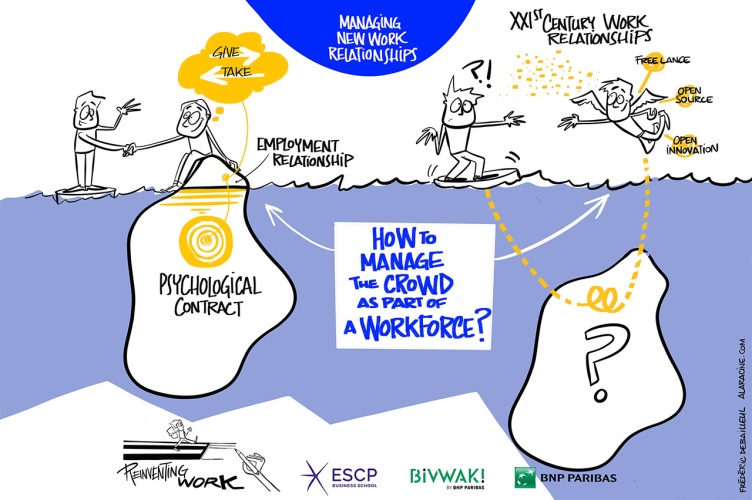
Managing new work relationships A fascinating project launched in June 2020
Research context
In today's professional world, a growing trend towards project-based work, performed by contingent and self-employed workers, is evident. For instance, 83% of executives surveyed by Oxford Economics (2020) reported increasingly using consultants, intermittent employees, or contingent workers in their operations.
Yet management theory and people management practices in organisations are still primarily oriented towards workers with employment relationships.
This project seeks to develop management theory to understand 21st century work relationships, by studying workers who are independent from the companies they contribute their work to. The project focuses on two types of independent workers: opensource software contributors and IT freelancers, providing complementary findings.
Research question
Overall question: How should workers that are external to the organisation be managed?
Initial focus - open-source contributors: Why do people contribute to open source and why do they stop?
Evolved focus – IT freelancers: How do freelancers experience and manage the tensions between insiderness and outsiderness? How do they develop a sense of insiderness? How does that influence their careers?
Methodology and milestones
This study consists of two sub-projects:
■ Open Source Contributors (2021–2022): Analysis of 159 threads from over 9,000 emails in an open-source project combining paid employees and volunteers to examine how contributors' participation evolves and ends.
■ Freelance Workers (2021–2024): Data collection included:
- Two rounds of qualitative interviews with 36 European freelancers
- A survey in three waves (three weeks apart) with 229 freelancers from Australia, New Zealand, the UK, and the US.
Reliance on psychological contract theory as the analytical lens.
Research team
Open source contributors
- Daniel Curto-Millet (University of Gothenburg)
- Almudena Cañibano (ESCP, Paris campus)
- Lukas Rojahn (ESCP, Madrid campus)
Freelancers
- Thomas Gigant (ESCP, Berlin campus)
- Kerstin Alfes (ESCP, Berlin campus)
Research keytake aways
1- Workers outside of employment relationships hold multiple psychological contracts with different actors (the project / fellow developers / users for open source contributors; the organization vs. the team for freelancers).
2- These multiple psychological contracts create tensions and contradictions than individuals must navigate and can influence the evolution of workers’ careers.
3- There is a compelling need to encourage a sense of ‘insider-ness’ of workers outside of employment relationships at the team level, rather than focusing exclusively on the organisational level.
This shift in perspective requires changes in human resource management and leadership practices, with a focus on developing a sense of belonging within teams.
4- Support from team members is crucial in this process, but its effect is mediated by social cohesion and team trust.
There should be active encouragement and support for team members (both employees and non-employees) to help colleagues and make contingent workers feel part of the in-group
Key outcomes
Published academic papers
■ Cañibano, A; Curto-Millet, D and Rojahn, L. (2022). “Sustained participation in open source: A psychological contract approach” Hawaii International Conference on System Sciences Proceedings (HICCS). T. De Vreede, D. Kong, GJ De Vreede. (Eds) Articles undergoing peer review (link)
■ Gigant, T, Alfes, K., Cañibano, A. (2024). “TeamBased Perceived Insider Status: Exploring the Drivers and Outcomes of Freelancers' Sense of Belonging to their Project Teams” Under review at Journal of Vocational Behavior
■ Gigant, T, Cañibano, A., Alfes, K. (2024). “The freelancer's paradox: mastering the tightrope walk between the insider and outsider’s worlds” Under review at Work Employment and Society
Campuses