
Distributed presence: designing togetherness in fully virtual organizations
A fascinating project launched in January 2021
Research context
What does it take to manage a distributed workforce? Drawing on lessons from location- independent organizations, we examine how organizational space can be created and sustained without the geographical proximity of colleagues.
Through the lens of Lefebvre’s triad of conceived, perceived, and lived space, we explore how space emerges through the beliefs of founders, the structuring efforts of managers, and the everyday interactions of employees.
Based on qualitative data from three location-independent firms and 37 interviews, we show that top-down practices such as routine meetings, shared calendars, and access to recorded work interactions foster distributed presence—a sense of responsiveness and connection akin to working in offices next to one another. This experience is supported by transparency, continuity, and responsiveness, allowing employees to stay aligned and feel embedded in a shared organizational rhythm. At the same time, employees bring space to life by initiating both work-related and informal relational ties.
Our findings offer practical insights for leaders organizing distributed work, emphasizing the importance of belief, structure, and relational effort in making virtual workspaces socially real and organizationally effective.
Research question
How is organizational space constructed and maintained when there are no walls, hallways, or offices to support it?
Methodology and milestones
We conducted 37 interviews with members of three location-independent organizations - which don’t have physical offices and where all the employees work remotely.
Research team
- Ekaterina Salovskaia-Leport (ESCP, Paris campus)
- Maral Muratbekova-Touron (ESCP, Paris campus)
Research keytake aways
1. Virtual work succeeds with a shared conviction that remote work is not a constraint but a viable way of operating. Founders and senior leaders play a crucial role in shaping this belief—not only by designing digital workflows but by consistently communicating, modeling, and embodying the legitimacy of virtual work.
2. While working remotely, we can recreate the feeling of working side by side through what we call distributed presence: the experience of responsiveness, transparency, and continuity that enables employees to stay aligned and feel embedded in a shared work rhythm. The following practices help make this possible:
- Design for responsiveness with visible rhythms and availability cues. Use shared calendars (e.g., Google Calendar), structured meeting routines (e.g., weekly team calls on Zoom or Google Meet), and real-time messaging tools (e.g., Slack) to recreate the feel of being “in the next room.” These systems allow employees to see when others are available and what they’re focused on, creating a sense of immediacy without constant check-ins.
- Foster transparency through open tools and communication norms. Make work legible by using open project boards (e.g., Trello, Notion) and shared task channels. Public Slack channels, rather than private messages, help surface information and align teams. Weekly team updates and shared KPIs further support alignment and reduce duplication of effort.
- Preserve continuity through digital memory. Invest in recording tools (e.g., Loom, Zoom recordings, Notion wikis) to document decisions, client interactions, and team processes.
- Enable informal and bottom-up interactions. Even with structure in place, virtual space only becomes alive when employees feel free to reach out, chat, and share beyond tasks. Support informal Slack channels (e.g., #random, #pets), pairing tools (e.g., Donut for weekly coffee chats), and spontaneous video calls. These small moments build trust and emotional connection that formal tools alone cannot replicate.
Attention points: Virtual organization, Location-independent organization; Organizational space; Distributed work, Distributed presence
Key outcomes
Presentation of the research at various international conferences.
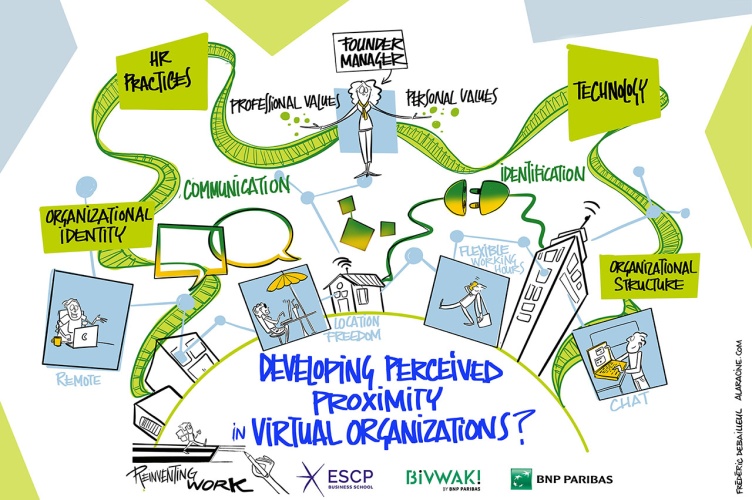
■ “Developing Perceived Proximity in Virtual Organizations” - 5 th Global Conference on IHRM, New York, USA, May 2022
■ “The Role of Work Relationships in Producing Virtual Organizational Spaces” - 6 th Global Conference on IHRM, Gothenburg, Sweden, June 2024
■ “Production of Virtual Organizational Spaces: The Case of Virtual Organizations” – EGOS 2024, Milano, Italy, July 2024
■ “Navigating The Digital Realm: Constructing Organizational Space in Purely Virtual Organizations” – AGRH 2024, Barcelona, Spain, October 2024
■ “The Role of Work Relationships in Producing Virtual Organizational Spaces” - AOM Doctoral Consortium, Copenhagen, Denmark, July 2025
Published academic papers:
■ “Distributed presence: designing togetherness in fully virtual organizations” to be submitted to Academy of Management Perspectives in December 2025
Campuses