

ESCP Business School hosts inaugural DEC Leadership Summit EMEA on AI and the future of higher education
Senior university leaders from across EMEA gathered in Paris to discuss AI governance, institutional transformation and the future of learning
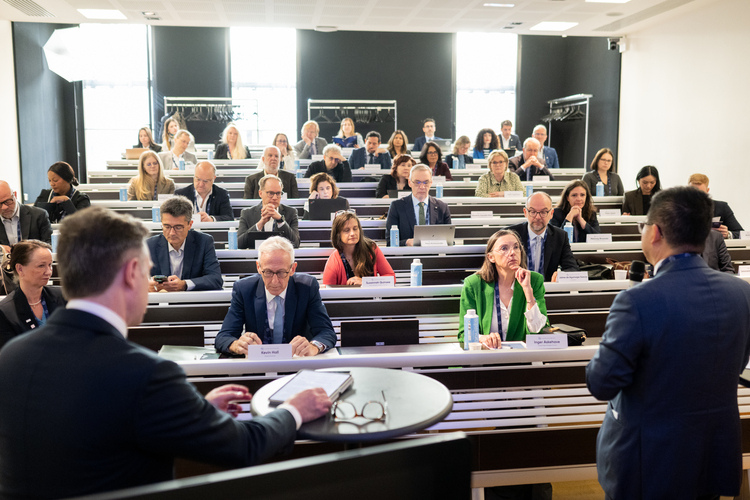
On 12 May 2026, ESCP Business School welcomed senior higher education leaders from Europe, the Middle East and Africa to its Montparnasse campus in Paris for the inaugural DEC Leadership Summit EMEA, organised by the Digital Education Council (DEC).
Representatives from 27 institutions across 15 countries joined the one-day summit to exchange perspectives on artificial intelligence, university transformation, governance challenges and the future of higher education in an AI-driven world.
Hosted by ESCP as official partner, the Summit was designed as a collaborative leadership forum focused on strategic dialogue rather than traditional conference presentations. The event created a space for candid peer-level discussions on the evolving role of universities as AI reshapes education, employability and institutional leadership.

Why AI is becoming a strategic priority for universities across EMEA
Artificial intelligence is rapidly transforming the higher education landscape across Europe, the Middle East and Africa.
Throughout the Summit, participants discussed how universities are facing growing pressure to adapt to changing student expectations, evolving workforce needs and increasingly complex regulatory environments.
According to research shared during the Summit:
- 51% of employers already expect AI proficiency as a baseline competency for graduates
- Only 3% believe higher education institutions are keeping pace with AI demands
- 48% of students say they feel unprepared for an AI-enabled workplace
- 39% of faculty members have not yet integrated AI into their teaching practices
These findings reinforced a central message of the day: AI is no longer simply a technology discussion. It is now a leadership, governance and institutional transformation challenge.
Leadership in higher education is entering a new era
Universities must adapt faster to technological and societal change
The Summit opened with discussions on how AI, automation and regulatory developments are accelerating institutional change.
Participants explored how university leaders are increasingly required to make strategic decisions faster than traditional governance structures were designed to support. Conversations focused on the evolving responsibilities of higher education institutions in preparing students for an AI-driven economy while maintaining academic integrity and public trust.
A recurring idea throughout the discussions was the need for universities to become more proactive rather than reactive in shaping the future of education and work.
Trust, assessment and academic credibility emerged as key themes
One of the strongest themes of the Summit was trust.
As generative AI tools continue to change how students learn, write and produce knowledge, institutions are being challenged to rethink assessment methods, academic rigor and the student-faculty relationship.
Participants discussed how universities can preserve academic credibility while embracing innovation, and how responsible AI governance must become a core institutional capability.
The opening reflection — “Be the student you want to see in your class” — set the tone for the day’s conversations about accountability, learning culture and leadership.
AI governance and institutional readiness remain major challenges
Institutions across EMEA face different realities but similar pressures
DEC’s overview of the EMEA higher education and policy landscape highlighted important regional differences in AI adoption and regulation.
European institutions are adapting to frameworks such as the EU AI Act and GDPR, while universities across Africa and the Middle East face challenges linked to infrastructure, AI access, governance maturity and digital equity.
Despite these regional differences, attendees identified a shared issue across the sector: institutional frameworks for AI governance are not evolving as quickly as AI adoption itself.
Universities need coordinated AI strategies, not isolated initiatives
Another major topic addressed during the Summit was execution.
Participants explored why many institutions continue to struggle with fragmented AI initiatives despite significant investments in tools and technologies.
Several recurring challenges were identified:
- Disconnected AI pilot projects
- Insufficient faculty support and AI literacy
- Lack of measurable institutional outcomes
- Difficulties scaling AI initiatives across departments and programmes
Leaders agreed that successful AI transformation requires coordinated institution-wide strategies integrating governance, curriculum development, faculty engagement and operational planning.
ESCP reinforces its commitment to innovation and responsible AI integration
By hosting the inaugural DEC Leadership Summit EMEA, ESCP Business School reaffirmed its commitment to contributing actively to the future of higher education and responsible AI adoption.
The Summit reflected ESCP’s broader ambition to foster international collaboration, academic innovation and strategic dialogue around the major transformations impacting education and society.
As AI continues to reshape universities globally, initiatives such as the DEC Leadership Summit provide institutions with opportunities to exchange best practices, strengthen governance frameworks and collectively rethink the future of learning.
What comes next after the DEC Leadership Summit EMEA
The Summit concluded with discussions focused on the DEC EMEA roadmap for 2026–2027 and future collaboration opportunities across the region.
Key priorities identified included:
- AI governance frameworks
- Faculty AI readiness
- Curriculum transformation
- Institutional benchmarking
- Shared research and collaboration models
Following the event, the Digital Education Council will publish a synthesis report summarising the strategic insights and priorities emerging from the discussions in Paris.
The conversations initiated during the Summit are expected to continue through future DEC working groups and at the DEC Global Summit 2026 in Madrid.
Relevant link
Campuses