
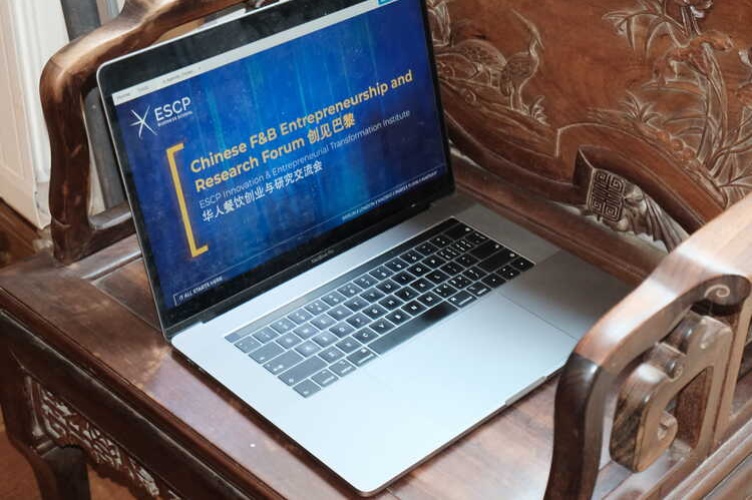
New research from Professor Yi Dragon Jiang suggests entrepreneurship often develops gradually through identity, experience and changing life circumstances rather than a single business decision.
When we think about entrepreneurs, we often imagine people spotting an opportunity, writing a business plan and making a conscious decision to launch a company.
But according to new research presented at ESCP, that picture only tells part of the story.
At The Secrets of Taking the Plunge, an event organised by ESCP's Innovation and Entrepreneurial Transformation Institute (Say), Professor Yi Dragon Jiang and doctoral researcher Kaiwen Ji shared emerging research that challenges some of the most common assumptions about how entrepreneurs come into being.
Drawing on interviews with Chinese entrepreneurs who established restaurant businesses across Europe, their work suggests that entrepreneurship often emerges gradually through migration, work experience, family relationships and changing life circumstances rather than through a single defining moment.
Entrepreneurship can emerge through "drifting"
One of the research team's emerging projects introduces the concept of entrepreneurial drifting.
Rather than beginning with a clear ambition to start a business, many entrepreneurs gradually find themselves moving towards entrepreneurship as opportunities, constraints and everyday decisions accumulate over time.
Migration experiences, family networks, previous employment and practical necessities all contribute to shaping entrepreneurial pathways long before individuals even think of themselves as entrepreneurs.
Instead of asking "When did you decide to become an entrepreneur?", the research suggests we may need to ask a different question: "How did entrepreneurship gradually become part of your identity?"
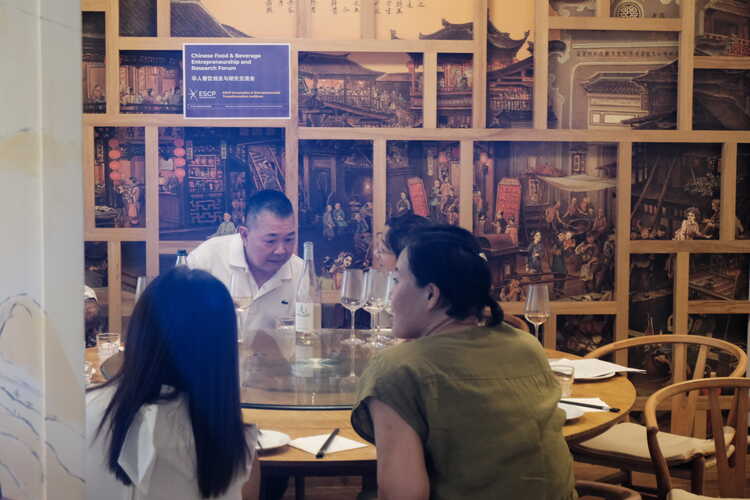 Participants discuss entrepreneurial journeys during the Chinese Food & Beverage Entrepreneurship and Research Forum hosted by ESCP's Innovation and Entrepreneurial Transformation Institute (Say).
 Entrepreneurs navigate between uncertainty and certainty
A second research stream examines how entrepreneurs experience uncertainty during venture creation.
Entrepreneurship is often described as operating under constant uncertainty. However, Professor Jiang and Kaiwen Ji found that entrepreneurs continuously move between periods of uncertainty and certainty as they redefine problems, adjust expectations and build confidence through experience.
Rather than waiting until uncertainty disappears, entrepreneurs progressively reshape the challenges they face until they identify actions they feel capable of taking.
This dynamic process helps explain why entrepreneurial action continues even in highly uncertain environments.
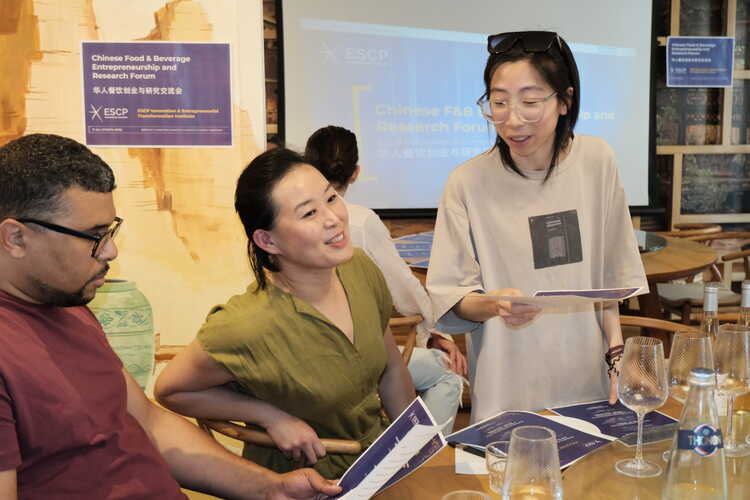 Professor Yi Dragon Jiang (centre) speaks with participants during the Chinese Food & Beverage Entrepreneurship and Research Forum at ESCP Business School.
 Beyond venture creation: entrepreneurship as identity development
The research also challenges how entrepreneurship programmes are typically evaluated.
According to Professor Jiang, policymakers and entrepreneurship educators often focus almost exclusively on whether participants successfully create businesses. Her research suggests this overlooks one of entrepreneurship's most important developmental functions.
These ideas build on Professor Jiang's broader research into entrepreneurial emergence, including her article "Unfolding Refugee Entrepreneurs' Opportunity-Production Process — Patterns and Embeddedness", published in the Journal of Business Venturing. Co-authored with Christian Straub, Kim Klyver and René Mauer, the study explores how refugees create entrepreneurial opportunities through evolving social relationships and embedded experiences rather than simply discovering existing market gaps.
Together, these projects suggest entrepreneurship is not simply about recognising opportunities—it is also about developing identity, agency and the capacity to imagine new futures.
Policymakers and entrepreneurship educators often equate successful entrepreneurship with successful venture creation. My research suggests that this overlooks an important developmental function of entrepreneurship.
For people experiencing disruption, such as refugees or people arriving in Europe without an established identity, entrepreneurial ideation can help individuals rebuild continuity, explore future selves and develop an entrepreneurial identity even before a venture emerges—or even if one never does.
This implies that entrepreneurship programmes should not be evaluated solely by venture outcomes, but also by their ability to foster identity development, agency and long-term entrepreneurial capacity.
Research in dialogue with entrepreneurial practice
The event created an opportunity to discuss these emerging findings directly with entrepreneurs whose personal experiences reflected many of the patterns identified by the research.
By bringing academic research into conversation with practitioners, the discussions demonstrated how qualitative research can deepen understanding of entrepreneurial behaviour while remaining closely connected to real-world experience.
Hosted by the Innovation and Entrepreneurial Transformation Institute (Say), the event reflects ESCP's commitment to producing research that advances academic knowledge while informing entrepreneurship education, public policy and entrepreneurial practice.
The research presented forms part of Professor Yi Dragon Jiang and doctoral researcher Kaiwen Ji's ongoing work on entrepreneurial emergence, entrepreneurial identity and new venture creation.
The event and papers presented form part of ongoing research on entrepreneurial emergence and new venture creation led by Professor Yi Dragon Jiang and doctoral researcher Kaiwen Ji.
Campuses