
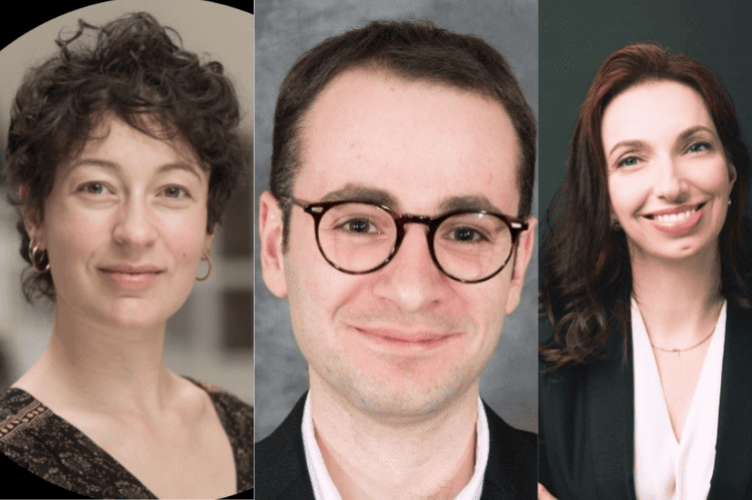
Over the past years, the Reinventing Work Chair has grown into an intellectual laboratory for exploring how work is being reshaped — through hybrid models, shifting expertise, and the rise of AI.
At the center of this mission lies a strong commitment: supporting doctoral research that deepens our understanding of these transformations while staying firmly grounded in organizational reality.
Today, we are proud to highlight three PhD projects supported by the Chair, each offering a unique window into the future of work.
1. Making Sense of AI in Organizations — Sophie Geneste
When Sophie Geneste began her CIFRE PhD in partnership with Bivwak! in 2021, questions around AI were everywhere — but often clouded by uncertainty. Her research set out to understand how individuals actually experience AI inside organizations, beyond the rhetoric and the technical discourse.
Over three years, she immersed herself in the daily life of teams experimenting with AI tools. Through dozens of interviews, multimodal content analyses, and more than 150 hours of observation, she uncovered a complex landscape where expectations, fears, and imaginaries constantly interact.
Her work shows how data scientists often operate as “boundary spanners,” navigating conflicting roles and expectations without falling into the usual traps of role strain. She also reveals how deeply science-fiction-inspired myths about AI continue to shape conversations, strategies, and power relationships within organizations. Perhaps most strikingly, her latest findings introduce the idea of faith-like acceptance: a form of AI adoption rooted not in rational evaluation but in symbolic narratives, rituals, and a willingness to believe without fully understanding.
Beyond its academic contributions, Sophie’s research generated concrete outcomes — from internal workshops and webinars to practical tools, including a visual guide for AI communication and an image-based maturity assessment.
2. Rethinking Expertise in the Age of Data Science — Valentin Mesa
With Valentin Mesa’s research, the Chair turns to another decisive transformation: how data science is reshaping the boundaries of expertise. His investigation began at BNP Paribas Personal Finance, where long-established scoring practices — anchored in decades of statistical know-how — now coexist with emerging data-science-driven models.
Valentin’s fieldwork reveals that the rise of data science creates not only new skills but also new tensions. Data scientists must carve out legitimacy in environments where traditional forms of expert knowledge are deeply institutionalized. At the same time, new hybrid actors — data workers operating business tools and databases — play a crucial yet often invisible role in enabling data-driven practices.
Through this work, Valentin highlights the ongoing redefinition of expert work: a landscape where mathematics, computer science, operational knowledge, and organizational history all coexist, sometimes reinforce each other, and sometimes collide. His research raises an essential question for HR and leadership: how can organizations support expertise when the very notion of “expert” is being reimagined?
3. Leading in a Hybrid World — Isabelle Bouisse-Bloigu
In 2024, Isabelle Bouisse-Bloigu embarked on a PhD to understand what leadership looks like in a world where teams are increasingly hybrid — spread across locations, time zones, roles, and communication rhythms. Her research takes place across seven BNP Paribas entities, offering a rich view of the many ways hybrid work is lived and led.
Her findings highlight the renewed importance of Cultural Intelligence (CI). While CI was long associated with global teams and cross-cultural contexts, Isabelle shows that it has become just as vital for hybrid leadership. CI helps leaders make sense of behaviors that might initially look like disengagement or resistance. It enables them to adapt their leadership style to the diverse expectations that hybrid work brings — expectations around autonomy, structure, visibility, communication, and work-life boundaries.
Isabelle’s work reveals hybrid leadership as a subtle craft: choosing the right moments to be present, the right channels to communicate, and the right balance between synchronous and asynchronous interactions. In a world where collaboration is increasingly fragmented, CI offers leaders a powerful lens to maintain cohesion, trust, and fairness.
🌱 Growing a Research Ecosystem to Understand the Future of Work
Together, these three doctoral projects embody the spirit of the Reinventing Work Chair: a belief that understanding the future of work requires deep, long-term inquiry — rooted in field research, attentive to lived experience, and connected to organizational realities.
They remind us that behind every technological or structural transformation lie human stories, collective uncertainties, and evolving forms of meaning-making.
We are proud to have supported these researchers and excited to see how their work will continue to inform the way organizations navigate hybrid work, expertise, and human-AI collaboration.
More research updates will follow in the months ahead.
Campuses