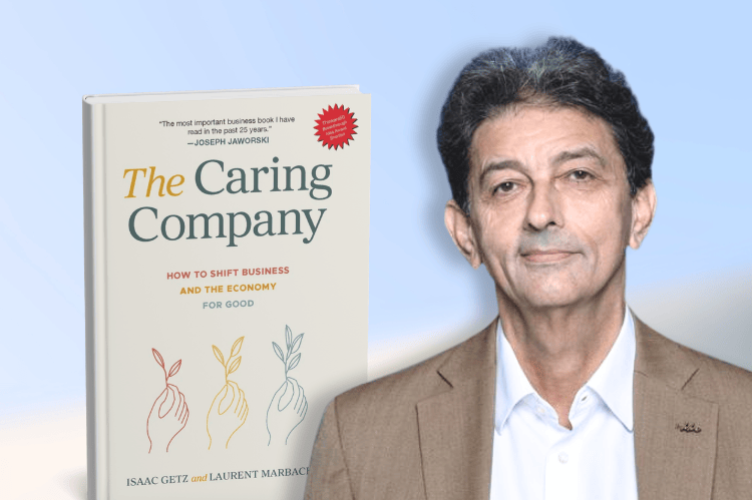
An interview with Professor Isaac Getz about his new book: The Caring Company.
With their new book The Caring Company: How to Shift Business and the Economy for Good (Wiley, November 2025), ESCP Professor Isaac Getz and co-author Laurent Marbacher argue that businesses that care unconditionally maximise their social value and demonstrate higher financial performance than their profit-driven competitors.
In The Caring Company, recently featured in the Financial Times, the co-authors lay out a radically new approach to business that, though conceptual, is thoroughly evidence-based: they studied dozens of caring companies of all sizes, types and geographies. We spoke to Getz about the inspiration behind the book and how to accelerate a shift towards more caring businesses and a more caring economy.
From liberated to caring companies
Since his 2009 book Freedom, Inc., Getz has championed liberated companies: firms built on trust that enable employees to act with freedom. Close to 500 companies and public service institutions have been transformed through the principles of liberated companies.
But a question remained. “I asked myself: what about the outside? How about the relationships companies have with customers, suppliers, and local communities?”
The Caring Company shifts that focus—from internal culture to external care—and explores the nature of a business’s relationships with the members of its ecosystem, relationships traditionally based on self-interested transactions.
Rethinking the business approach
In the book, Getz and Marbacher start with the observation that transactional relationships, though efficient, erode trust and loyalty. “The answer for most companies if they ask whether their stakeholders are willing to go the extra mile for them is no.”
By contrast, caring companies forge deeper, longer-term relationships by caring unconditionally through their core business processes. Having highly loyal customers, dedicated suppliers, and supportive local communities all contributed to these businesses' higher results and resilience.
Grounded in a multi-year study across industries and on three continents, the book blends insights from history, economics, psychology and philosophy with contemporary cases. These companies aren’t social enterprises or nonprofits. They are mainstream, market-driven firms, some of which are large, publicly traded multinationals.
Though capitalistic and welcoming profits, caring companies don’t put profits first.
These companies treat profit like water—essential for survival, but you don’t live to consume as much of it as possible. Firms that put care first, not only generate social value–the common good–but also, consequently, enjoy higher economic prosperity.
 Isaac Getz
ESCP Professor
Eisai: one case of unconditional care
Among the many case studies in the book, Getz and Marbacher share one that stands out. After a major secondary effects scandal that Haruo Naito, CEO of the large Japanese pharmaceutical company Eisai, thought was caused by the pure pursuit of profits, he asked his employees a simple question:
"What are we really here for?"
The eventual answer became a turning point: “Our purpose is to relieve the suffering of our patients and their families.”
The CEO invited employees to rethink their activities to contribute to this new purpose. This led to hundreds of actions, like salesmen organising congresses for doctors in remote regions to help them better diagnose Alzheimer's — without the typical goal of distributing drug samples. The result? Better ability to diagnose and treat the disease by doctors, and, as a byproduct, unmatched levels of goodwill among the doctors. This made Eisai, over time, their preferred drug company.
The human engine of change
Caring companies depend on employees who feel trusted and empowered to provide unconditional care. This is where Getz’s works converge: liberated organisations where employees have the discretionary power to act are needed to make unconditional caring possible.
When we started to study these caring companies, it became obvious that those who provide this unconditional care are employees. It's not enough for the CEO and top management to call for unconditional care. It's the employees who have to deliver it to customers, suppliers, and the local communities.
Isaac GetzESCP Professor
For ESCP students who will go on to lead and shape business in the coming years – many of whom belong to a generation deeply concerned with purpose and impact – the book offers a powerful message.
Getz says the next generation does not necessarily need to compromise their values, and The Caring Company shows that they can have a fulfilling career with purpose at the right organisations. “Don’t give up on your values. Don’t think you need to check them at the door.”
He also encourages students to see business as a powerful force for good: “If you want to make the world a better place, the leverage that businesses have may be the strongest, perhaps stronger than that of social enterprises and even of the government.”
Why care matters now
“Increasingly, businesses are facing legitimate criticisms that they are privatising profits and socialising risks and damage to society,” notes Getz. “This has led to growing distrust of businesses, particularly big ones.
The Caring Company presents a different model that is not an illusory utopian way to run a business. The ideas are grounded in examples from real organisations—such as Swedish Bank Handelsbanken, which has been using this model for over 50 years and continues to outperform its competitors.
The book challenges companies to move beyond mere compliance and extractive models, and instead, operate based on unconditional care and, as a consequence, enjoy incomparable results.
In doing so, it redefines the meaning and the contents of business. And, Getz suggests, this might be the only way capitalism can truly meet the challenges of our time.
Relevant Links
Campuses