
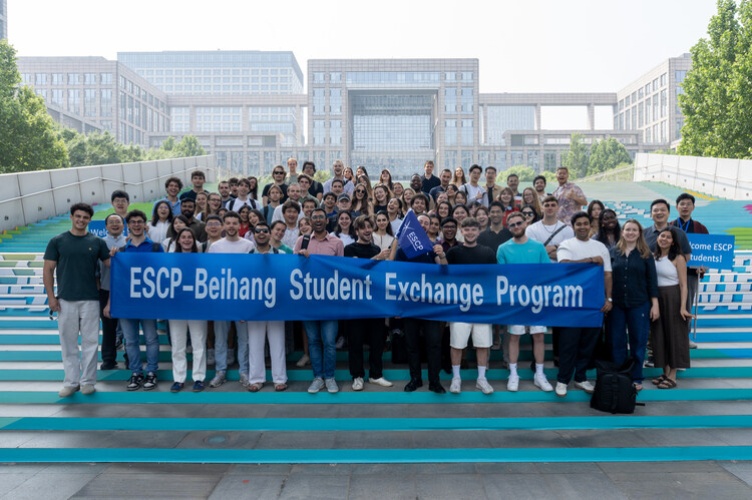
In Beijing, ESCP MSc in Business Analytics & AI students explored how artificial intelligence is transforming business, while strengthening cross-cultural ties with Beihang University.
In May 2026, 82 students from ESCP’s MSc in Business Analytics & AI programme travelled to Beijing for a week-long exchange with Beihang University’s School of Economics and Management (SEM). Representing 20+ nationalities, the cohort spent the week visiting leading Chinese technology companies, attending lectures on deep learning and large language models, designing and deploying their own AI agents, and immersing themselves in Chinese culture.
Opening Ceremony and the AI Agent Challenge
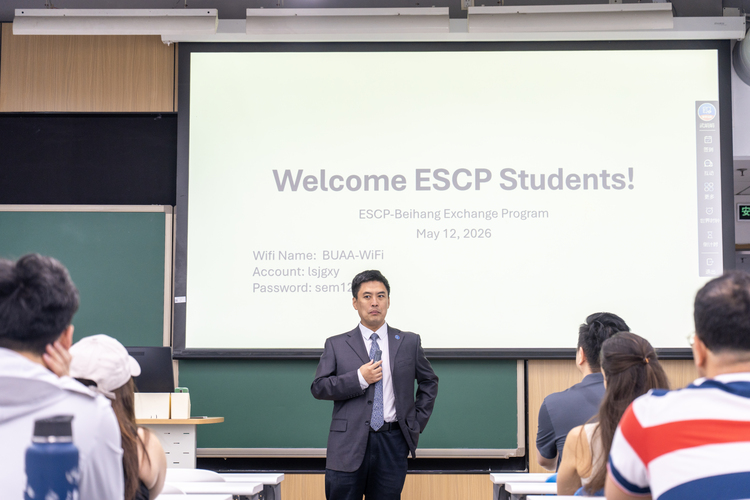
The programme opened on 12 May with a welcome ceremony. On behalf of the school, Beihang SEM’s Vice Dean Professor Jin-Xing Hao extended a warm welcome to the visiting ESCP faculty and students. Reflecting on a partnership that has now spanned nine years – built on a solid foundation of cooperation and a deep friendship – he encouraged the students to make the most of the rich week ahead: to immerse themselves in Beihang’s campus atmosphere and the charm of Chinese culture, to exchange ideas and spark new thinking through seminars and field visits, to experience first-hand how big data analytics is applied across different industries, and to take away a distinctive cross-cultural experience.
Professor Hao Zhong, who led the ESCP delegation, thanked Beihang for its steadfast support of the exchange over the years, as well as for the warm hospitality and seamless organisation of the week. He encouraged the students to make the most of their time in Beijing – to engage fully in every session and visit, to learn with open and curious minds, and to return home with a rich harvest from the week ahead.
Professor Guannan Liu then walked the students through the week’s schedule before turning to the core of the programme: the AI agent, powered by large language models (LLMs). Drawing on real-world cases, he introduced agents through four key building blocks – the brain (the agent itself), planning, memory, and tool use.
He closed by setting the cohort’s capstone task: each team would design its own AI agent, aiming either to improve a company’s management in some dimension or to offer constructive new ideas for a start-up.
Deep Learning Lecture and a Visit to Yonyou
On the morning of 13 May, Professor Guannan Liu delivered a lecture titled “Foundations and Applications of Deep Learning.” Opening with familiar AI use cases such as autonomous driving, he traced the evolution of deep learning before explaining the mechanics of model training – gradient descent, forward propagation, and back-propagation. He then introduced key techniques and tools, including Long Short-Term Memory networks (LSTM) and the PyTorch framework, and walked students through the design rationale and typical use cases of convolutional neural networks (CNN) for image recognition, recurrent neural networks (RNN) for sequence modelling, and the Transformer architecture for natural language processing.Throughout the session, students raised questions on technical details and practical challenges, which Professor Liu addressed one by one.
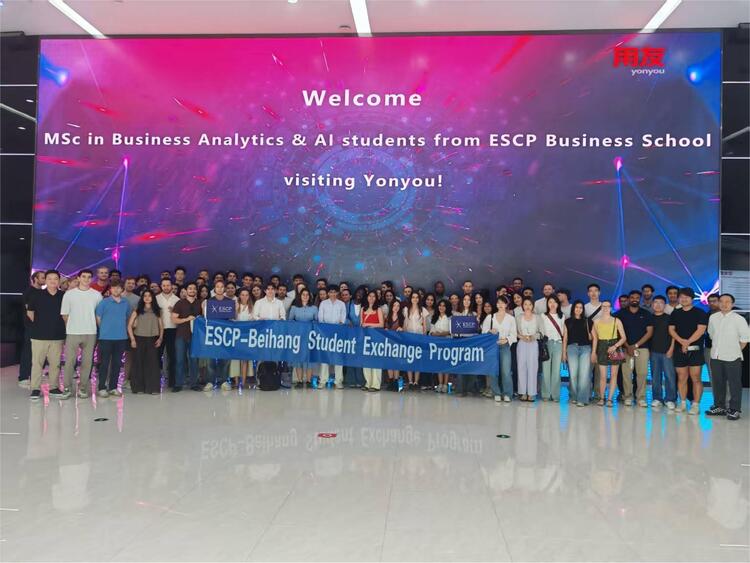
That afternoon, the cohort visited Yonyou (用友) Network Technology’s smart-enterprise experience centre, exploring how cloud finance, the industrial internet, and AI come together in real business settings. Live demonstrations of an intelligent management dashboard and real-time data interaction gave students a vivid sense of how Chinese enterprises are driving industrial digital transformation. In the discussion that followed, students engaged Yonyou’s experts on cross-border compliance, the differences between Chinese and European management practices, digitalised ESG practices, and how digital tools can empower start-ups and strengthen the resilience of global supply chains.
A Visit to Geek+
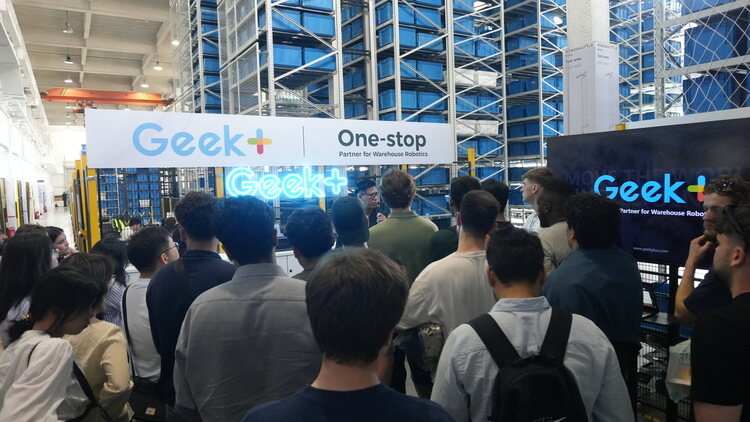
On 14 May, the group visited Geek+ (极智嘉). Touring the company’s showroom and intelligent-warehousing solutions area, students focused on Geek+‘s core business and global footprint in autonomous mobile robots (AMR), smart warehouse management systems, and flexible logistics automation. Live demonstrations of collaborative robotic sorting, intelligent material handling, and real-time fleet scheduling showed how artificial intelligence, automation, and smart supply chains converge in modern commerce, and highlighted Chinese technology firms’ advanced practice and capacity for innovation in logistics digitalisation. In the exchange that followed, students drew on the European market to discuss how Chinese and European firms differ in their automation pathways, shifts in workforce structure, and the development of green logistics.
Dialogue with Beihang Students
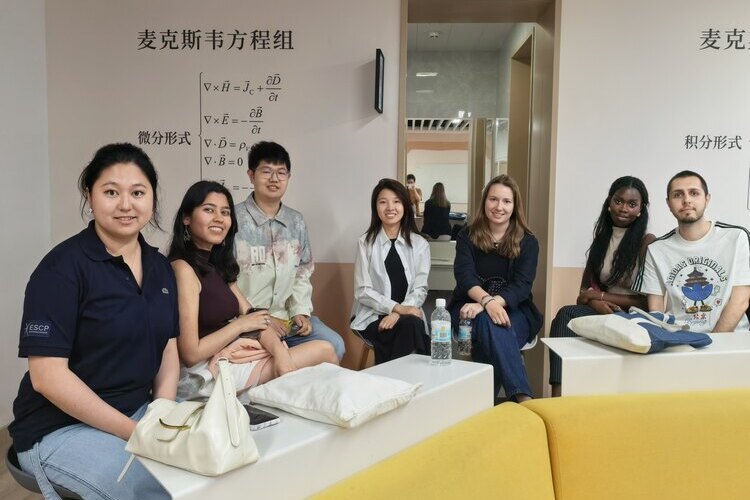
On 15 May, ESCP students sat down with Beihang graduate researchers for a candid conversation about AI, business, and everyday life in China. They compared how the technology is adopted on either side of the world – from China’s all-in-one super-apps to Europe’s stronger emphasis on privacy and data protection – and agreed that, as AI takes over routine tasks, human judgment, creativity, and leadership matter more than ever.
AI Agent Presentations and Closing
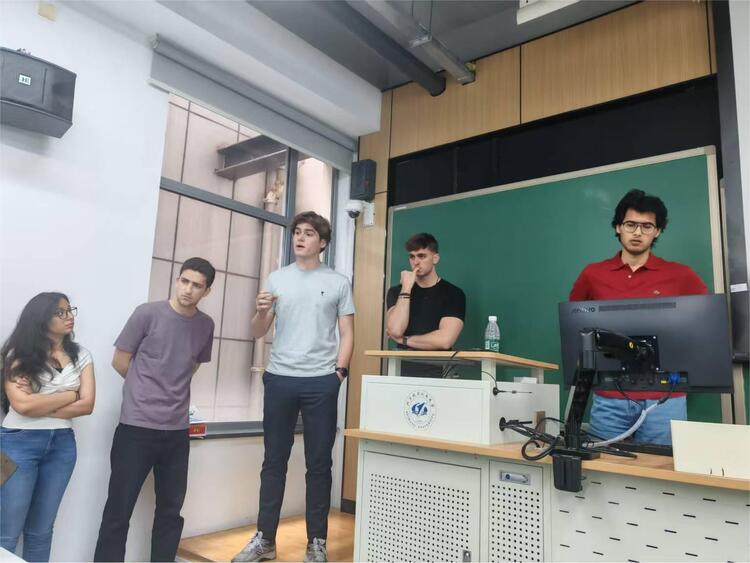
The week culminated on 16 May with the AI agent project, “Build Your Own AI Agent for Business and Social Good.” Working in ten teams, students had moved from concept to working prototype in just a few days, presenting their agents before a panel of ESCP and Beihang faculty.
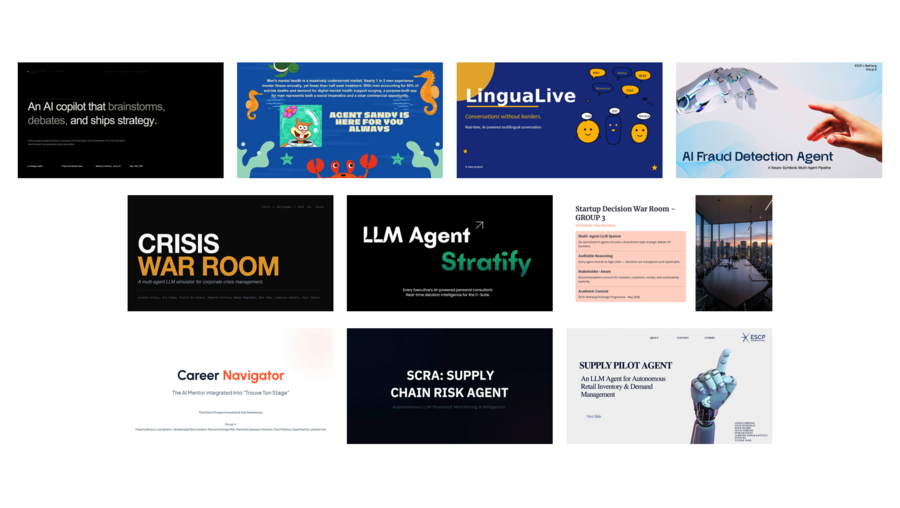
Across all ten projects, recurring themes emerged: multi-agent collaboration, retrieval-augmented reasoning, and autonomous decision-making – the building blocks of a new generation of business applications. The seminar then drew to a close with a farewell luncheon.
The projects showcased the breadth of agentic AI:
- An AI Career Navigator combined retrieval-augmented generation with long-term memory to deliver personalised, context-aware career guidance – an agent designed to learn and grow with each user.
- A real-time translation agent broke down language barriers in a live on-stage demonstration, applying LLMs to an everyday, high-impact scenario.
- A supply-chain risk agent chained five stages of reasoning into an automated pipeline, monitoring exposure across global trade routes and Chinese ports.
- A crisis-management agent walked through a real incident case, coordinating multiple specialised sub-agents to support faster, better-informed decisions under pressure.
Experiencing Beijing
Beyond the formal programme, the week left ample room for students to explore Beijing: many wandered the Forbidden City, walked the Great Wall, and strolled through the Summer Palace, while others sampled the city’s culinary landmarks, from Peking duck to hotpot.
Together, ESCP and Beihang continue to equip the next generation of global leaders with the knowledge, skills, and vision they need not only to understand AI, but to build it – and to shape a smarter, more responsible, data-driven future.
Related Link
Campuses