
CONFERENCE REPORT
Paris, February 23-25, 2026 | ESCP Business School
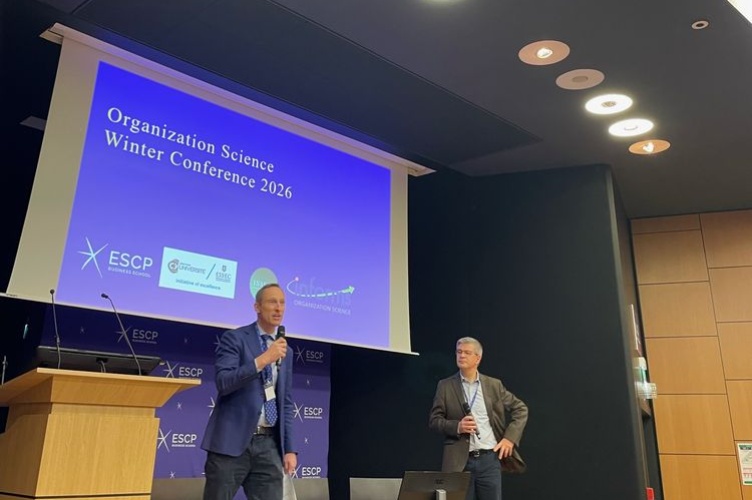
From February 23 to 25, 2026, ESCP Business School hosted the Organization Science Winter Conference (OSWC) 2026, organized by Chang-Wa Huynh (ESCP) and Ruthanne Huising (ESSEC) along with their co-organizers. The event gathered over a hundred researchers from across the world around the key questions reshaping work today.
Yaelle Amsallem, post-doctoral researcher at the Reinventing Work Chair, had the opportunity to volunteer at the conference. This report highlights the findings most relevant to the Chair's research agenda.
The conference was opened by Regis Coeurderoy, Dean of Research at ESCP, who highlighted the school's commitment to world-class management research, and by Lamar Pierce, Editor-in-Chief of Organization Science, who set out the journal's vision for the field.
Panel "Work from Where?": Where We Work and Why It Matters
On Wednesday morning, the panel "Work from Where?", chaired by Nicole Abi-Esber (LSE), brought together three researchers examining the new geographies of work from organizational, psychological and gendered perspectives.
1. The Organizational Barycenter — Megan Lawrence (Vanderbilt University)
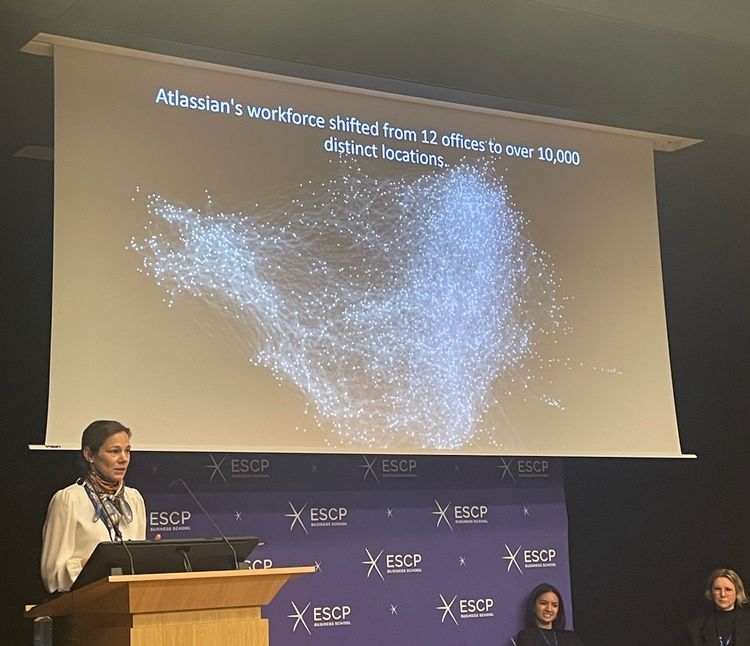
Megan Lawrence introduced the concept of the organizational barycenter, a weighted average of all employee locations inspired by the physical notion of center of mass. As organizations become radically distributed (Atlassian went from 12 offices to over 10,000 distinct locations), traditional dispersion measures fall short. The barycenter provides a computationally efficient, time-varying spatial reference point that identifies where aggregate coordination costs are minimized.
Drawing on over 30 million worker-job records from Revelio Labs, she shows that fully flexible firms see their barycenter drift further from headquarters than hybrid firms, and that greater distance is associated with increased coordination slack. The measure has broad applications: informing team meeting locations, time zone alignment, and even cultural dispersion analysis.
2. The Power of Presence — Sonya Mishra (Dartmouth College, Tuck School of Business)
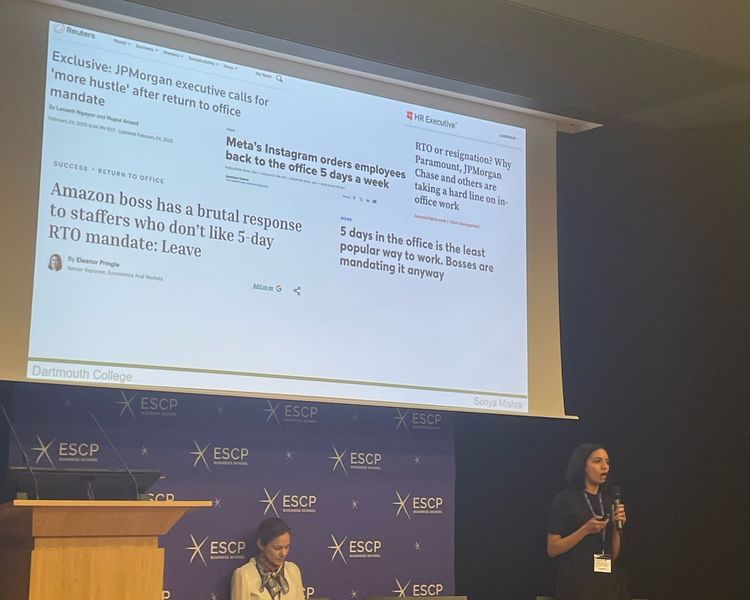
Sonya Mishra offered a psychological explanation for return-to-office (RTO) mandates. Power holders tend to be strongly identified with their organizations, an identification sustained by visibility, proximity and informal deference in physical settings. Remote work disrupts these processes, driving those with decision-making authority to support RTO policies.
Her model reframes organizational identification not as a consequence of work location policies, but as a driver of them. It also suggests that remote work flattens the lived experience of organizational hierarchy, which may partly explain the resistance it generates at the top.
3. Who Cares? Hybrid Work and Gendered Relational Practices — Kim de Laat (University of Waterloo)
Kim de Laat examined how hybrid work disrupts relational practices, the informal activities essential to organizational functioning that are traditionally coded as feminine and undervalued. Based on interviews across three organizations, she identifies two key mechanisms at stake:
- Anticipatory work (gauging colleagues' capacity and needs) relies on physical cues that vanish remotely.
- Communality (small talk, emotional check-ins, informal support) is compressed by the efficiency logic of virtual meetings.
Women are disproportionately affected by the reduced visibility that hybrid arrangements create. De Laat calls for formalizing relational task-sharing in policies, building platforms for informal connection, and embedding relational competencies in performance evaluations and leadership training.
Key Takeaways
Taken together, these three presentations illustrate how the question of work location touches on measurement, power and gender in equal measure. They offer concrete tools and frameworks for organizations navigating hybrid work, and speak directly to the research agenda of the Reinventing Work Chair.
Campuses