
Inside the ESCP ecosystem equipping a new generation to turn breakthrough science into ventures that can survive and scale
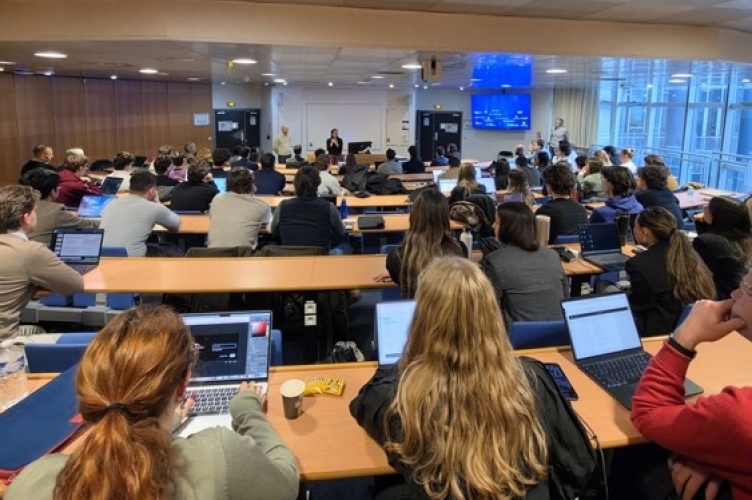
In an amphitheatre at ESCP Business School’s Champerret campus, founders sit alongside investors, researchers and students. This is ESCP’s Deeptech Entrepreneurship Showcase—the culmination of a three-month course in which 44 ESCP students have worked in sprint-based teams with 10 startups across fields including TechBio, synthetic biology, quantum, SpaceTech, and advanced materials. The course is built around one difficult question: what does it really take to move science from lab to market?
Bridging a persistent gap
For years, Vincent Galand, co-creator of the deeptech entrepreneurship course at ESCP, observed a troubling pattern. Working with the ESCP Innovation and Entrepreneurial Transformation Institute (Say Institute) to deliver a 9-month programme targeting PhD students, postdocs and researchers to turn scientific work into entrepreneurial projects, he witnessed strong science consistently fail to translate into commercial success. "I kept seeing the same pattern: strong science, but real difficulties around market understanding and business positioning," Galand explains.
His experience showed him that while Europe has an abundance of scientific talent, it often lacks the bridge between technical excellence and commercial execution. He then connected with Martin Kupp, Professor of Entrepreneurship at ESCP Business School, who was encountering the same challenge from a teaching perspective.
An experience with a physics professor in his EMBA course, who was trying to bring fusion energy out of the lab and into the market, was illuminating for Kupp. “That made me realise quite quickly that the entrepreneurship frameworks I had been teaching were not really designed for this kind of challenge.”
Many entrepreneurship models today are built around digital ventures. Deeptech follows different rules. “The timelines are longer, the uncertainty is greater, and the path to market is far less linear,” adds Kupp. Addressing this challenge led the pair to build the first dedicated deeptech entrepreneurship course for MiM students at ESCP.
Why deeptech ventures struggle to scale
The barriers only start with the mismatch between research and venture timelines. Deeptech startups often require years of development, technical validation and costly iteration before generating revenue. As Galand puts it, “Physical reality does not iterate like an algorithm.”
Scale-up presents a second challenge. Moving from proof of concept to industrial deployment demands not only funding, but also infrastructure, manufacturing capacity, supply chains and the right partners. Finally, fragmentation across the ecosystem remains a major obstacle. Without alignment between investors, customers, operators and institutions, even strong science can struggle to reach the market.
For Kupp, addressing these challenges starts with one key capability: bridging science, engineering and business from the outset. “In deeptech, these worlds meet early, but they do not follow the same logic,” he explains. “They move at different speeds and define success differently—a founder focuses on execution and survival, a researcher on scientific validity, and an investor on timing, defensibility and risk.” Developing profiles able to navigate these differences is essential to turning breakthrough science into scalable ventures.
The ESCP approach: learning through real-world constraints
The ESCP deeptech course is designed to bridge scientific innovation and market application through hands-on collaboration. “We do not teach deeptech as something abstract,” Galand says. “We put students in contact with real startups, real constraints, and real delivery expectations.”
The course is built as a ten-week, sprint-based collaboration with ventures operating across frontier fields. Students work on actual strategic questions, whether around market segmentation, adoption barriers, governance, or go-to-market priorities, developing the skills needed to operate at the intersection of innovation and execution.
Beyond the classroom, ESCP's deeptech ecosystem amplifies this learning. Through ESCP’s Blue Factory incubator and partnerships with institutions such as Bpifrance, CentraleSupélec and Université Paris Cité, these interactions are embedded in a wider network of actors shaping deeptech innovation. “The final showcase is often a key moment, because their work has to make sense beyond the classroom,” adds Kupp.
The need for this pathway is clear. As Galand notes, around 90% of deeptech founders at pre-seed stage come from PhD backgrounds, while roughly 75% of these teams have no commercial co-founder. That is exactly the kind of gap the course tries to address. “Students are not expected to become scientists, but they do need to learn how to work seriously at the interface between the lab and the market,” says Galand. “That is the core of our approach.”
A strategic shift for ESCP
This initiative reflects a broader shift within the School. With the planned launch of the ESCP School of Technology in 2027, the institution is expanding its focus on the intersection of science, business and entrepreneurship, aiming to develop leaders who can navigate emerging technologies and drive meaningful transformation.
“My ambition is for ESCP to become one of the places in Europe where deeptech is treated in a serious and structured way as a strategic field at the intersection of science, entrepreneurship and execution,” Kupp says.
Galand would like ESCP to keep strengthening its role as a place where deeptech ventures can be shaped and supported in concrete ways. “That means more bridges with founders, researchers, investors, technical schools, and industry partners,” Galand shares. “It also means giving students more opportunities to work on live deeptech problems and contribute in a tangible way.”
Shaping the future of deeptech innovation
Deeptech innovations will define the future of energy systems, healthcare, manufacturing and sustainability. Europe’s ability to compete depends not only on its capacity to generate knowledge, but on its ability to transform that knowledge into impactful companies.
Without that transformation, innovation risks remaining confined to laboratories, disconnected from the industries and societies it is meant to serve. For Kupp, business education has a critical role to play. "I think business schools have a real role to play here, because one of the recurring problems in deeptech is not the science itself, but the lack of people able to connect that science to markets and growth."
Relevant Links
Campuses