
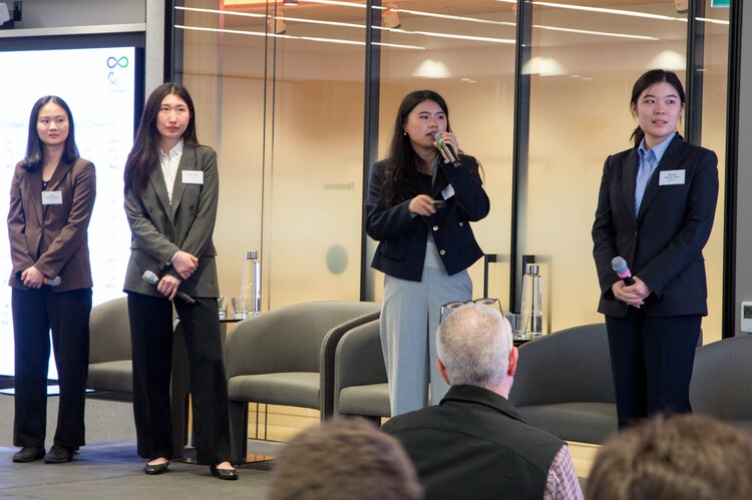
Yujing Zeng on reaching the finals in the Accounting for Sustainability International Case Competition and what she learned from transforming environmental risk into business value
In business education, sustainability is often discussed in broad terms: a responsibility, a necessity, a moral and strategic imperative. But for Yujing Zeng, ESCP Master in Management (MiM) student, it became something more concrete through the Accounting for Sustainability International Case Competition (A4SICC): an international challenge in making the business case for sustainability.
This year’s competition brought together 535 students from 89 schools across 31 countries, with 132 entries focused on 100 companies. Yujing’s team, Greenflow, advanced to the finals in Toronto, while another ESCP team, Nature500, reached the semi-finals — with two teams in the top 20, it was a strong showing for the School in one of the world’s leading student sustainability competitions.
“It is both an honour and a responsibility to represent ESCP in a global competition like A4SICC,” shares Yujing. “As an institution known for its strong international identity and emphasis on sustainability, I felt that I was representing not only my own perspective, but also the values and academic environment that ESCP embodies.”
It is both an honour and a responsibility to represent ESCP in a global competition like A4SICC. As an institution known for its strong international identity and emphasis on sustainability, I felt that I was representing not only my own perspective, but also the values and academic environment that ESCP embodies.
ESCP Master in Management (MiM) student
Finding value in constraints
Yujing’s team’s case focused on Nutrien, a Canadian agricultural company, and a problem not usually associated with innovation: the management of gypstack, a byproduct often treated as an environmental and financial burden. Greenflow’s proposal asked a different question. What if that liability could be turned into value?
The team developed a two-part strategy: repurposing gypstack into wetlands that could support biodiversity, while also exploring its use in premium phosphate fertilisers as a new commercial product. The proposal was both environmental and financial in its logic, reframing a costly burden as a possible source of resilience and innovation.
“Working on a real business case made me realise that sustainability is not only about responsibility, but also about identifying opportunities within constraints,” shares Yujing. “This shifted my perspective from seeing sustainability as a cost or obligation to viewing it as a potential driver of innovation and value creation.”
From theory to practice
For Yujing, the competition helped her develop a more practical and nuanced understanding of sustainability. “This experience has significantly reshaped how I think about sustainability in a business context. It shifted my perspective from something more conceptual to something practical and value-driven.”
She also highlights the importance of mentorship and support throughout the process. Gorgi Krlev, Professor and Associate Dean of Sustainability at ESCP, offered coaching and guidance to the ESCP teams in the competition.
Professor Krlev sees competitions like A4SICC as an important expression of what applied learning can look like.
“Competitions like A4S show what applied learning looks like: students tackle some of the world’s most complex challenges, demonstrate how their solutions make business sense,” he shares. “Students must combine acumen, creativity and analytic precision to succeed.”
Competitions like A4S show what applied learning looks like: students tackle some of the world’s most complex challenges, demonstrate how their solutions make business sense. Students must combine acumen, creativity and analytic precision to succeed.
 Gorgi Krlev
Professor and Associate Dean of Sustainability at ESCP
Learning across borders and perspectives
The international dimension of the competition made the experience even more meaningful. Team Greenflow brought together students from different schools and backgrounds, and Yujing was the only finalist based in Europe. The experience demanded not only strong analysis, but also adaptability, communication and trust.
For Yujing, that felt closely connected to ESCP’s identity. “Participating alongside students from diverse backgrounds was an enriching experience. It allowed me to contribute a European perspective to the discussion, while also learning from different approaches and ideas from other regions.”
For Yujing, the competition became a way of representing not only herself, but also a broader way of learning that defines the ESCP: international, collaborative and grounded in the practical application of business thinking to real-world challenges.
Relevant Links
Campuses