
The Greenprint series explores the distinctive sustainability identities of ESCP’s campuses, highlighting the people and initiatives shaping a shared vision for responsible leadership and collective impact.
As Sustainability Manager, Laetitia Langlois has been supporting ESCP’s sustainability transformation since joining the School in 2020. Her work spans all aspects of campus life, from fostering student engagement and managing sustainability certifications to representing the School’s commitments to external stakeholders and developing strategic partnerships, among many other initiatives. We spoke to her about how sustainability is taking shape at ESCP’s Paris campus and across its European network.
Sustainability started through the engagement of multiple actors at the local level, at their own scale. This is how we were able to be one of the first business schools with a sustainability course, in 1992 already.
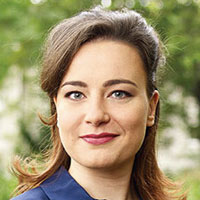 Laetitia Langlois
Head Sustainability Manager, ESCP Paris Campus & Federal
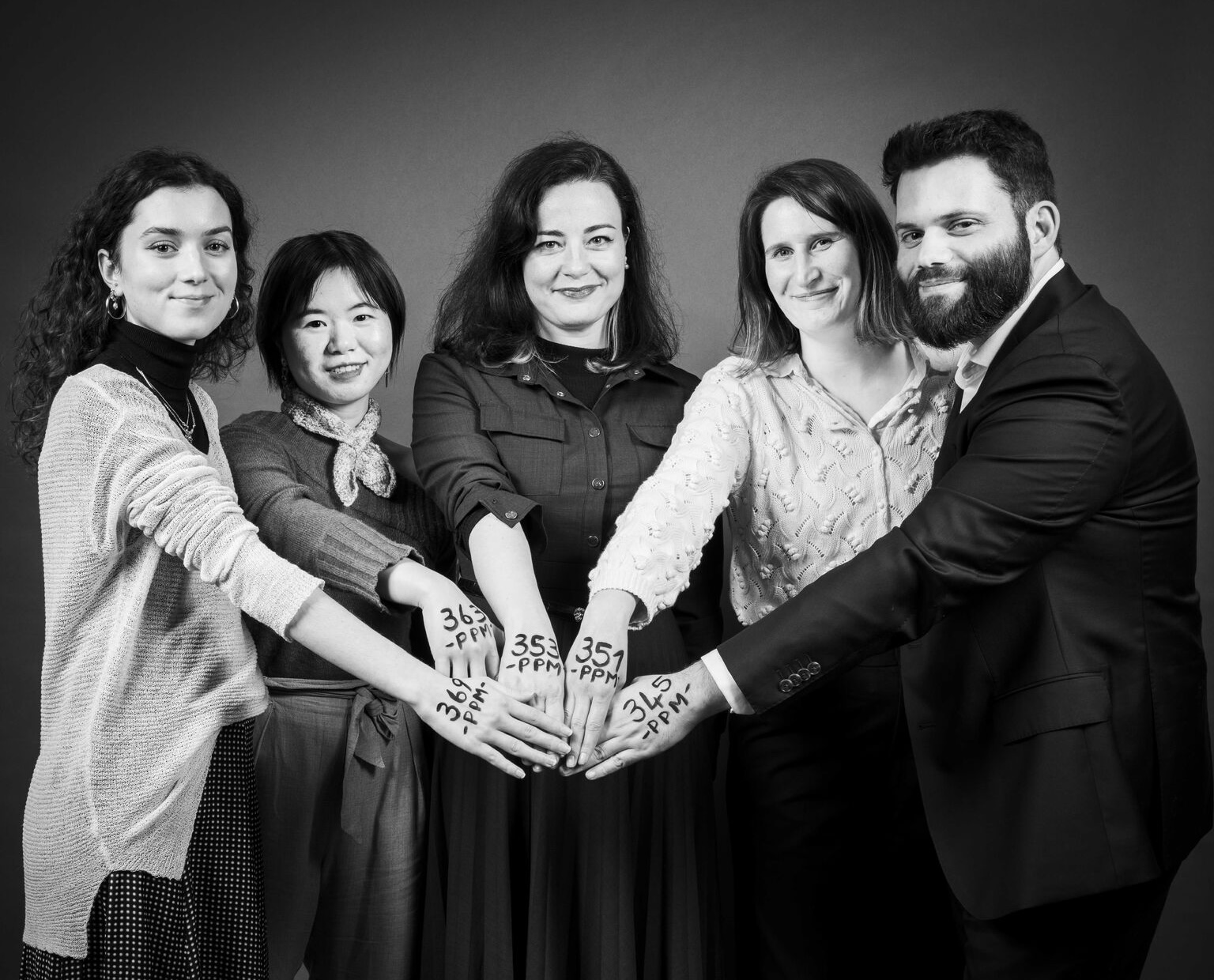
Sustainability team at the ESCP Paris Campus
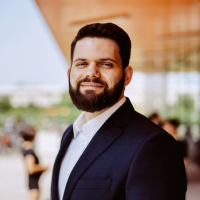 Gorgi Krlev
Associate Dean of Sustainability
Laetitia LangloisHead Sustainability Manager, ESCP Paris Campus & Federal
 Runzhou Lei
Lead Carbon Reduction & Sustainability Strategy
 Gabrielle Tremblay
Ecological Transition Project Manager
The local lens
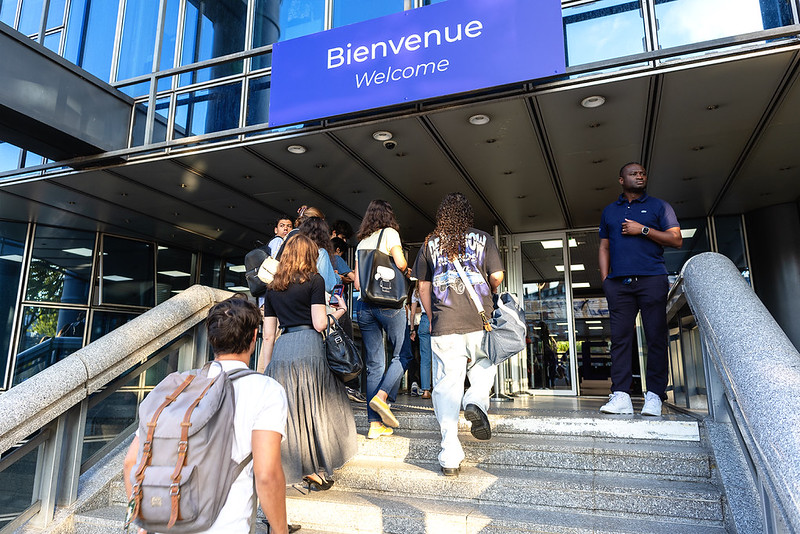
Paris holds a distinctive position within ESCP’s sustainability journey, combining both a local and a federal perspective. As the School’s historic campus, it is where sustainability first took root.
Beyond its legacy, Paris is also ESCP’s largest campus. Its scale makes it a natural testing ground, where new ideas can be piloted and refined before being extended across Europe. In that sense, Paris remains deeply anchored in its local environment while constantly operating with a broader, pan-European perspective.
This dual role is reflected in initiatives led from Paris, from the development of ESCP’s carbon reduction strategy—spanning energy, travel, procurement, catering and digital activities in line with the Greenhouse Gas Protocol—to a “curriculum revolution” embedding sustainability across disciplines.
These projects are carried forward by a closely connected team under the leadership of Associate Dean of Sustainability, Gorgi Krlev. Runzhou Lei leads the School’s carbon reduction roadmap, working across functions to align data and strategy. Gabrielle Tremblay coordinates transition projects, partnerships and certification processes, while contributing to the integration of sustainability into the curriculum. Laetitia Langlois connects these efforts across campus life, from student engagement to external partnerships and institutional commitments.
Working at the heart of the School’s European structure, the team drives and coordinates the institution’s sustainability transition across campuses and functions, in close collaboration with the “Green and Impact Offices” on each of ESCP’s other campuses.
“Sustainability doesn’t sit in one place,” says Langlois. “Our roles naturally overlap, and that’s what makes the work effective. It’s through constant collaboration across teams, campuses and functions that we can move forward in a coherent way.”
Initiative Spotlight: Designing Tomorrow
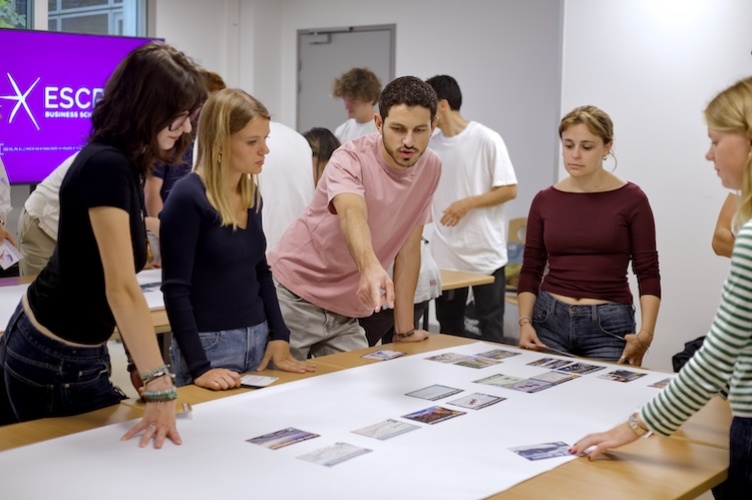
At the Paris campus, sustainability is woven into the very start of the student experience. One of the most striking examples is Designing Tomorrow, a three-day immersive seminar.
Originally launched as Rentrée du Climat, the seminar was designed to give incoming students a rigorous, science-based introduction to climate and societal challenges at the outset of their studies.
Conceived as a pivotal moment, it brings together climate science, business debate and real-world expertise. Researchers, practitioners and students exchange in interactive formats that leave little room for abstraction. From the outset, sustainability is framed not as a side topic, but as a defining issue of their generation.
Designing Tomorrow sets the tone for what follows. It establishes sustainability as a lens through which management and leadership must be reconsidered.
Engaging with the ESCP community
Sustainability efforts on the Paris campus are also shaped through everyday practices and the active involvement of the ESCP community.
One of the most tangible examples lies in campus catering, where a carbon footprint measurement initiative, developed under the School’s carbon reduction strategy led by Runzhou Lei, is currently being implemented. With more than 113,000 meals served annually, the cafeteria represents both a significant environmental footprint and a powerful lever for change.
By making the carbon impact of dishes visible, the initiative aims to inform choices and encourage more sustainable habits through transparency. It also opens the door to broader transformations, from increasing vegetarian options to rethinking menu design and sourcing practices.
As Luc Hay from the catering team explains, “We serve a large number of meals, and we wanted to reflect on how to best positively impact the environment and biodiversity. We are perpetually trying to improve ourselves.”
What makes the project particularly meaningful is the collaboration it reflects. Sustainability is also driven by operational staff who integrate these concerns into their daily work. From catering and facilities to international relations and campus operations, sustainability is progressively embedded across functions.
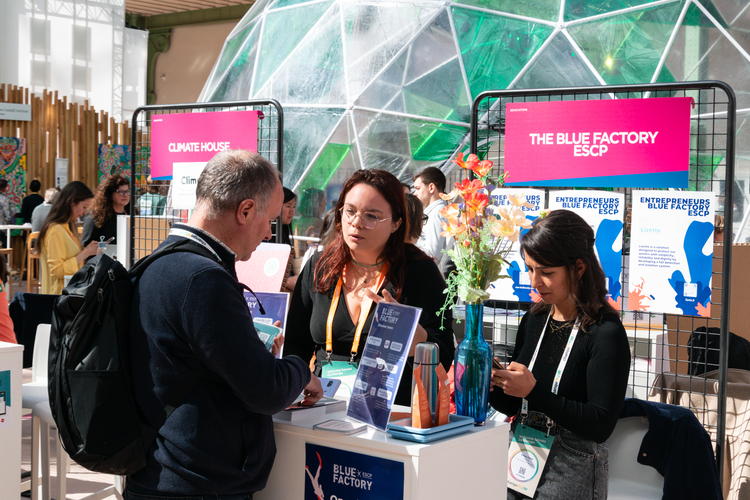
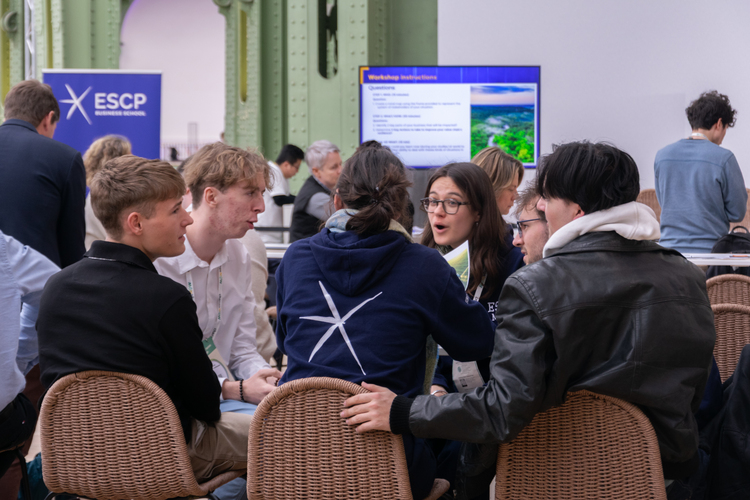
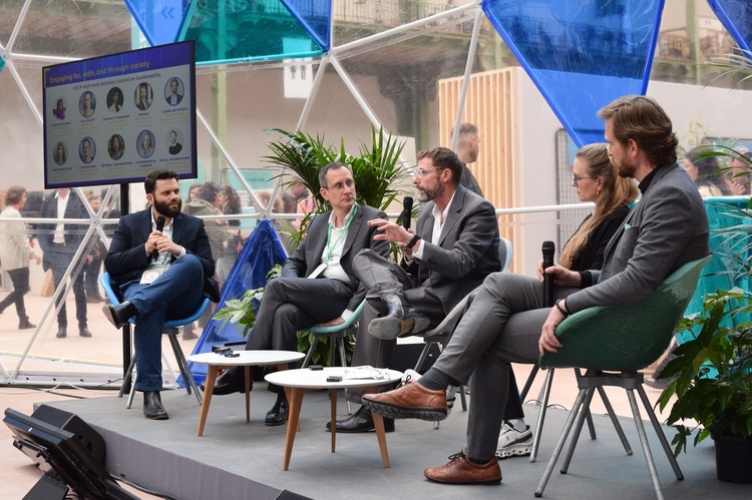
Throughout the year, students, faculty and staff also engage through conferences, events and partnerships, including major initiatives such as ChangeNOW, where ESCP acts as an academic partner. Building on this momentum, the Sustainability Advisory Council—launched at ChangeNOW in 2025—brings together leaders from fields ranging from climate science to finance to strengthen accountability while fostering innovation and impact.
Initially developed in Paris, many of these initiatives are designed to scale across ESCP’s other campuses, demonstrating how local experimentation can lead to collective transformation.
Sustainability Heroes
Several figures have played a key role in advancing sustainability at ESCP in Paris.v
Among the pioneers are Olivier Delbard, Aurélien Acquier and Valentina Carbone, who helped place sustainability at the heart of the School’s academic agenda. In 1992, Olivier Delbard launched ESCP’s first sustainability course, while Aurélien Acquier later founded the Sustainability Department and became the School’s first Associate Dean for Sustainability. Together with Valentina Carbone, he also co-created the Circular Economy chair with Deloitte.
A new generation continues to expand this work, including Lucie Baudoin, whose research focuses on water systems and climate adaptation, and Jozef Cossey, who works on helping leaders navigate planetary boundaries. Beyond academia, staff such as Laure Zilliox, along with teams in operations, catering and IT, also play a crucial role in advancing sustainability across the campus.
What’s next?
Among the next priorities is the rollout of ESCP’s carbon reduction plan, with Paris expected to serve as a testing ground before measures are extended across the School’s campuses.
Another key milestone will be the publication of the Sustainability and Social Impact Report, designed to share ESCP’s progress and commitments more transparently.
The team is also advancing initiatives on the responsible use of AI in close collaboration with the AI team, exploring how emerging technologies can be aligned with sustainability and ethical considerations.
Relevant link
Campuses