
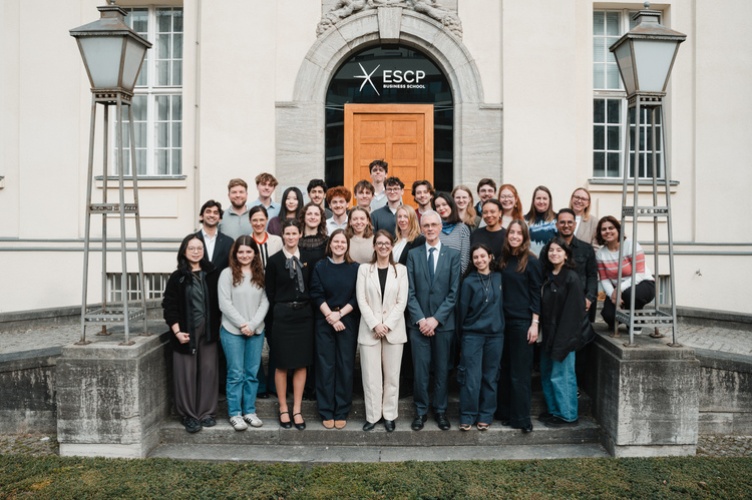
French Minister for Gender Equality and Fight against Discrimination: Aurore Bergé at ESCP Berlin
Advancing Gender Equality in an “Age of Storms”
On 24 March 2026, ESCP Business School’s Berlin campus welcomed Aurore Bergé, French Minister for Gender Equality and Fight against Discrimination, for a high-level discussion on the future of gender equality, human rights and international cooperation.
Bringing together policymakers, researchers and students, the event created a platform for dialogue on one of today’s most pressing societal challenges, and reaffirmed ESCP’s role in fostering cross-border debate on critical global issues.
A global challenge: Equality in times of uncertainty
Gender equality remains a fundamental issue affecting rights, opportunities and economic participation. As highlighted in the opening remarks, achieving equality requires both decisive political action and continuous societal dialogue across borders and cultures.
In her keynote, Minister Bergé described the current context as an “age of storms” for human rights. She pointed to increasing geopolitical tensions and diverging national approaches as key challenges, particularly regarding women’s and LGBTQ+ rights.
A central message: progress is not guaranteed. Equality must be actively defended and continuously reinforced.
Feminist diplomacy and new international alliances
Against this backdrop, Bergé outlined France’s approach to strengthening international cooperation through what she described as feminist diplomacy - positioning gender equality as a core dimension of foreign policy. With shifting global dynamics, including reduced engagement from traditional partners, France is focusing on building new coalitions across Europe, Africa and Latin America. These partnerships aim to advance human rights and support countries implementing progressive legislation.
At European level, she emphasised the importance of strong Franco-German cooperation to maintain a clear and unified voice on equality and democratic values.
A growing generational divide
One of the key concerns raised during the discussion was the emerging generational gap in perceptions of equality.
While past decades were marked by steady progress, recent developments suggest a more complex reality. According to Bergé, new ideologies and shifting attitudes - particularly among younger generations - risk slowing or even reversing progress.
Her conclusion was clear: Equality is not a given, but an ongoing effort that requires engagement, awareness and resilience.
Policy measures: Why quotas still matter
The role of quotas sparked particular interest during the student Q&A.
While acknowledging that quotas are not an ideal long-term solution, Bergé argued they remain necessary in the current context to ensure representation - especially in leadership positions and in sectors such as finance, STEM and technology.
Without such measures, she warned, progress could quickly stall or reverse.
At the same time, she stressed the importance of combining structural tools with broader efforts, such as education, awareness-building and addressing unconscious biases.
ESCP in action: Research, education and institutional change
The event also showcased how ESCP is addressing gender equality across research, teaching and institutional policy.
Women in Finance: Research and impact
The Chair of Women in Finance presented ongoing research into the lived experiences of women in a traditionally male-dominated industry. One key insight is the “visibility–invisibility challenge”: women often feel overlooked in discussions while at the same time standing out as minorities in leadership environments. This dynamic requires them to navigate carefully between gaining visibility for their contributions and avoiding increased scrutiny or stereotyping. The findings underline the importance of strengthening women’s agency to better manage this balance.
A structured Gender Equality Plan
ESCP also shared its institutional Gender Equality Plan, developed in line with eligibility requirements for European Union funding under the Horizon Europe Programme . The plan focuses on:
- equitable recruitment and career progression
- gender balance in in leadership and decision making
- integration of gender perspectives in teaching and research
- prevention of discrimination and gender-based violence including sexual harassment
Importantly, the plan is designed as an evolving framework, supported by continuous monitoring and evaluation rather than a one-off initiative.
Key takeaways
- Gender equality remains a central economic and societal challenge
- Progress is not linear and requires continuous effort
- International cooperation is shifting, requiring new alliances
- Quotas remain a necessary tool in the current context
- Education, research and institutional commitment are critical drivers of change
A platform for dialogue and future action
The event concluded with an engaged discussion between students and the Minister, reflecting a shared understanding that achieving equality requires both structural measures and collective responsibility.
By hosting this exchange, ESCP Berlin once again provided a space where academic insight, policy perspectives and student voices come together - contributing to informed debate and tangible progress on equality and inclusion.
Relevant link
Campuses