
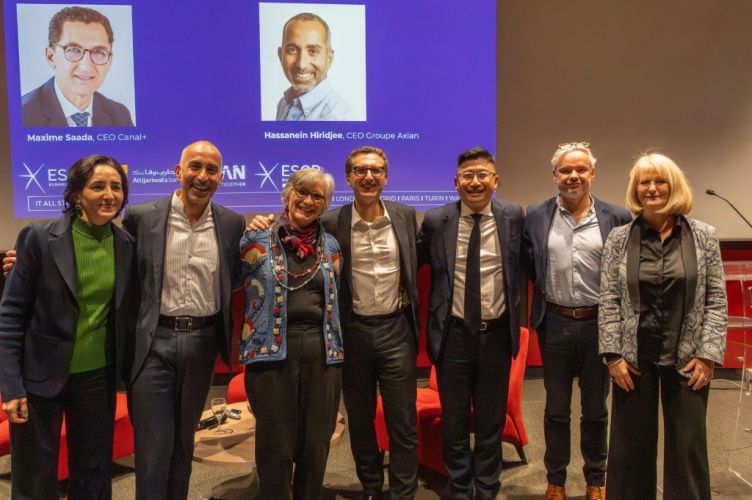
On March 26, ESCP Business School’s Paris campus hosted an ambitious, hands-on, and forward-looking event: “Family Business and Innovation in Africa”, led by the Chair for Responsible Innovation in Africa, supported by AXIAN Group and Attijariwafa Bank.
Designed as a key moment at the intersection of careers, academic reflection, and executive dialogue, the event brought together students, faculty, ESCP staff, and participants from other higher education institutions around a shared question: how are family businesses drivers of sustainable, inclusive, and transformative innovation across Africa?
In the afternoon, participants met with the HR teams of AXIAN Group, Attijariwafa Bank, and CANAL+ during job dating sessions, before continuing the conversation in the evening with a high-level debate featuring Hassanein Hiridjee, CEO of AXIAN Group, and Maxime Saada, CEO of CANAL+.
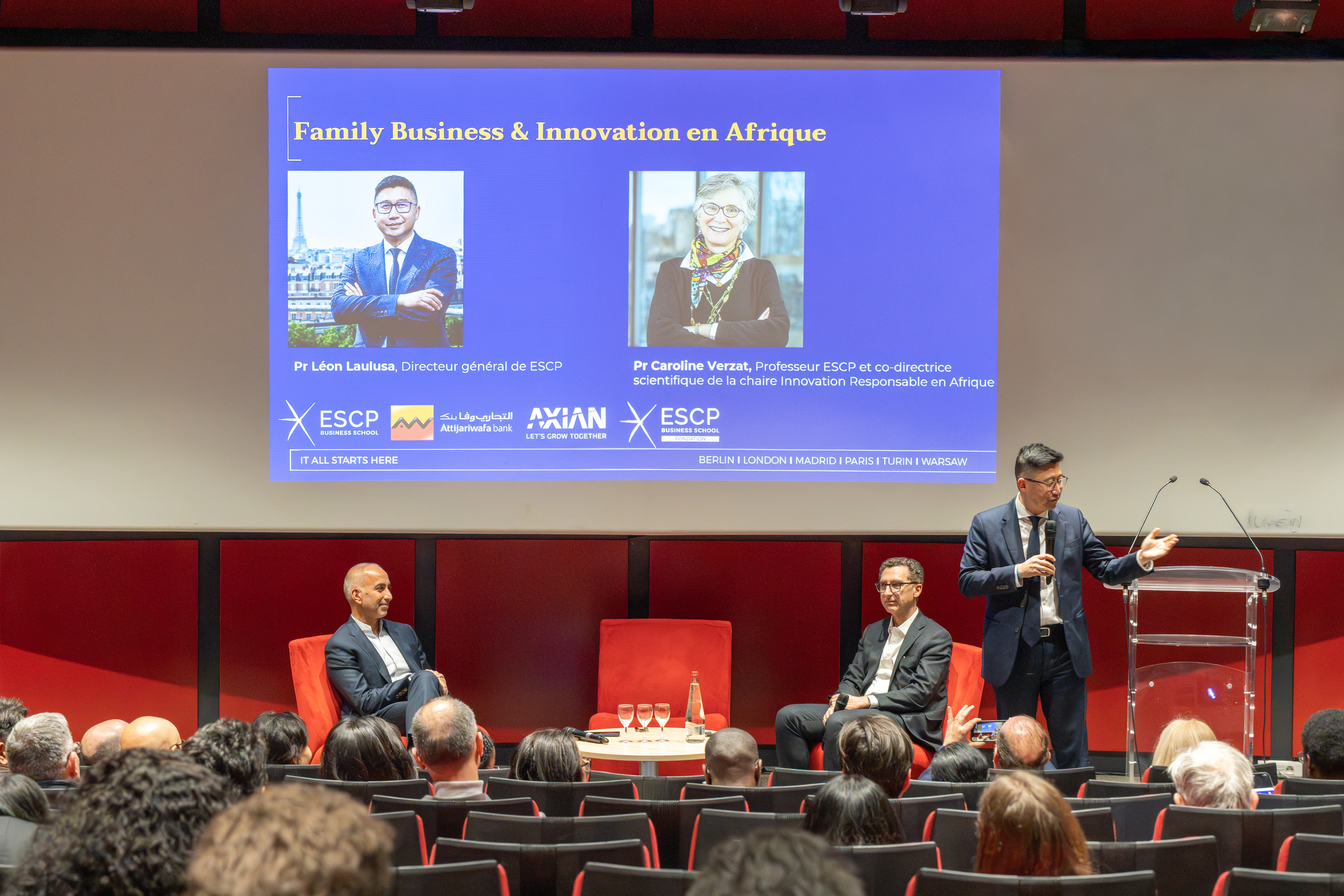
An opening focused on innovation and impact
Opening the conference, Prof. Léon Laulusa, Executive President and Dean of ESCP Business School, highlighted the strength of the theme, at the crossroads of three key realities:
“Tonight’s topic is essential, as it brings together family business, innovation, and Africa. These three forces speak to sustainable innovation, desirable innovation, and highly effective innovation.”
He emphasized that innovation should be understood not merely as technological progress, but as a broader force of transformation:
“Sustainable innovation is rooted in values, ethics, and cultural heritage. Desirable innovation transforms constraints into opportunities. And powerful innovation stems from the combination of agility and adaptability.”
This set the tone for the discussion: positioning innovation as an economic, social, and cultural lever for change.
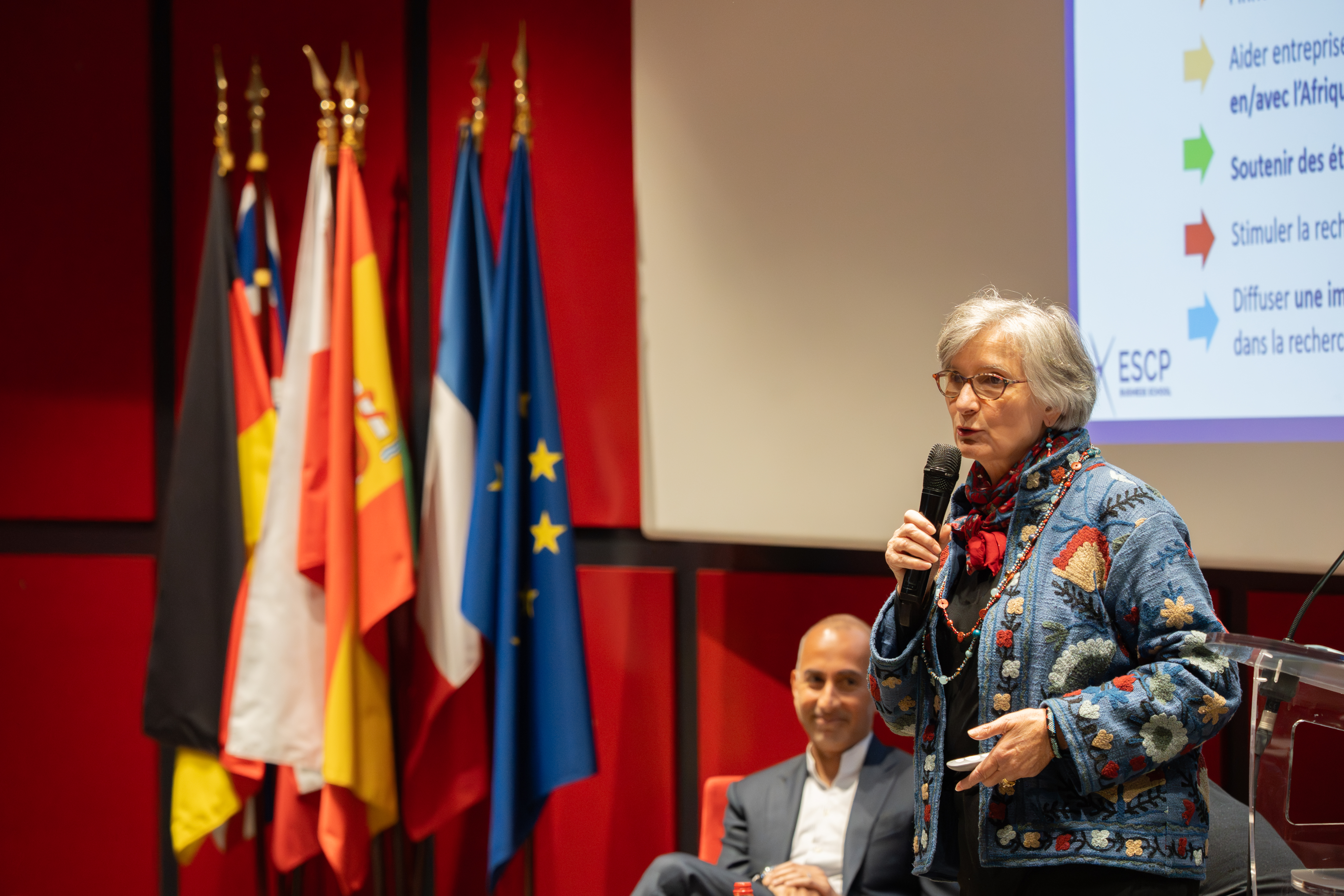
A Chair to educate, connect, and reshape narratives
Prof. Caroline Verzat, co-scientific director of the Chair for Responsible Innovation in Africa, then presented the mission and initiatives of the Chair, launched at ESCP with the support of AXIAN Group and later joined by Attijariwafa Bank.
“The Chair for Responsible Innovation in Africa is a small team with a very large mission: contributing to Africa’s transformation towards sustainable prosperity, and educating young people to make it happen.”
She explained how this ambition translates into concrete actions: academic programs, scholarships, partnerships with African institutions, internships, as well as research and knowledge production.
“Our goal is also to highlight that Africa holds a positive future, that remarkable things are happening there, and that the rest of the world can learn from the forms of innovation emerging on the continent.”
At the heart of the Chair’s approach is the ambition to connect education, research, business, and career paths, making both opportunities and the richness of African innovation more visible, from frugal solutions to cutting-edge developments.
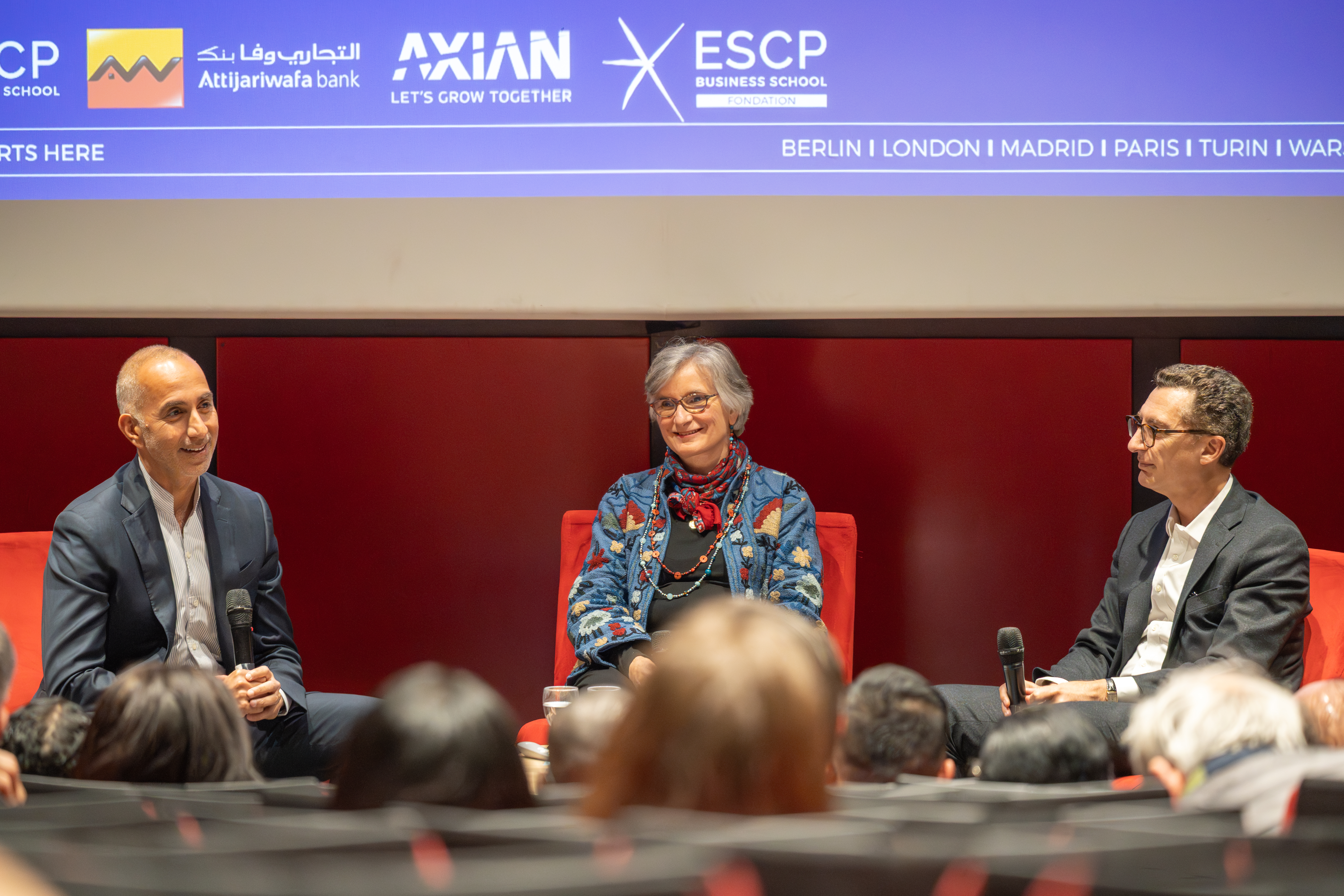
Hassanein Hiridjee: impact, boldness, and long-term vision
Invited to share his journey, Hassanein Hiridjee described the path that led him from ESCP to leading a family business that has become a major pan-African group, now operating in 21 countries across telecoms, fintech, financial services, energy and real estate.
His perspective highlighted the distinctive strengths of family businesses: long-term thinking, a greater capacity for risk-taking, and a strong sense of responsibility toward local communities.
“In a family business, capital is patient. That changes everything. You can invest in meaningful projects, even when returns are not immediate.”
He also stressed the importance of entrepreneurial boldness:
“Courage and audacity matter. When you choose to go where others don’t, in complex sectors or underserved areas, you need to deeply believe in what you are building.”
Among the initiatives he is most proud of, he mentioned the development of solar-powered mini-grids in remote rural areas, providing access to clean, decentralized, and affordable energy.
“Today, we bring electricity to villages where it never existed before. It is a decarbonized, digitalized, and decentralized innovation, and above all, one that changes people’s lives.”
Another key focus is financial inclusion through mobile services:
“In Africa, technology can sometimes move faster than elsewhere. What we have built in mobile money and digital financial services has a very direct impact: it simplifies daily life, reduces distances, and creates new opportunities.”
He also emphasized the importance of culture and transmission in innovation:
“We will go further, faster, if we know where we come from. Responsible innovation also means being proud of one’s culture and passing it on”
“Innovation is also about passing on knowledge. In Madagascar, the Foundation H — our arts foundation — enables thousands of children to discover contemporary art and creativity free of charge. More than 5,000 children have already benefited from this. Because cultural curiosity is the primary driver of innovation.”
Maxime Saada: telling African stories from within
Maxime Saada shared CANAL+’s transformation over recent years, from a group historically focused on France to an international player with Africa at the core of its strategy.
“With the acquisition of the media leader in English- and Portuguese-speaking Africa, MultiChoice, complementing its footprint in French-speaking countries, CANAL+ has established itself as the leading media group across the continent”
“Much of what we have achieved at CANAL+ would not have been possible without a long-term approach. That is one of the great strengths of a group with a family as reference shareholder.”
He highlighted how essential this mindset is for operating in Africa:
“When approaching Africa, you need patience, consistency, and a long-term ambition. You cannot build sustainably if you only think short-term.”
At the heart of his message was a strong conviction: Africa should not only be seen as a market, but as a source of stories, talent, and creative production with global reach.
“I am convinced that the most powerful stories yet to be told are real African stories.”
CANAL+ is therefore investing in local production, hyper-local content, vernacular languages, and training in audiovisual professions.
“It is not just about producing content in Africa, it is about enabling authentic African stories to travel across the world.”
He also stressed the need to invest in skills to structure creative industries:
“Training is essential. To produce, you need writers, technicians, editors, sound engineers, set designers, producers, an entire ecosystem must grow.”
Family business, responsible innovation, Africa: a powerful convergence
Throughout the evening, a common thread emerged: family businesses can play a unique role in transforming the African continent, provided they leverage their long-term vision to serve impact, local anchoring, and intergenerational transmission.
The discussion also highlighted key challenges: access to energy, skills development, financing, piracy in cultural industries, and the need for strong public-private partnerships. Yet beyond theory, it was concrete examples, strategic choices, and lived experiences that shaped the conversation.
The evening concluded with a networking cocktail, extending discussions between students, alumni, partners, and guests.
With this event, ESCP reaffirms its ambition to position the Chair for Responsible Innovation in Africa as a space for dialogue, knowledge, and action, contributing to a deeper understanding of Africa’s contemporary dynamics and the talents shaping its future.
Campuses