
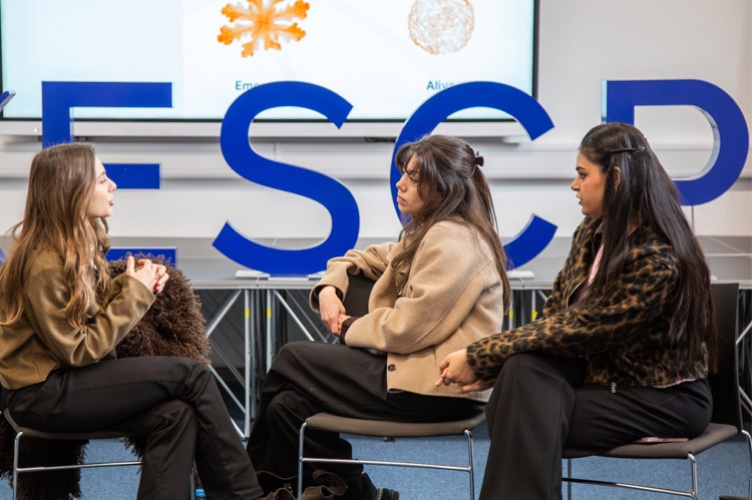
What happens when 22 companies, students and academics rethink impact together?
🔍 Highlights from ESCP’s 5th Social Impact Festival
The 2026 edition of the Festival brought together 22 industry partners to explore people-centred leadership and the future of responsible business
When people hear “social impact”, they often think of philanthropy, corporate social responsibility or charitable initiatives. In reality, it is about people, and the effect that business decisions have on their lives, experiences and wellbeing. This focus on people and decision-making was at the core of ESCP Business School’s fifth annual Social Impact & Sustainability Festival, held at its London Campus from 19th to 25th March. The Festival brought together students, academics, alumni and 22 industry partners to explore how social impact can be embedded across careers, organisations and complex market systems.
Throughout the week, conversations highlighted a shared understanding: as geopolitical tensions reshape economic priorities and technologies continue to transform the way organisations operate, companies must put responsibility, equity, and long-term value creation on par with profits. There is a growing need for leadership that places people and social impact at the centre of decision-making, instead of treating sustainability and impact as add-ons or tick-box exercises.
Responding to the shifting UK and global priorities
The 2026 edition marked ESCP's largest Social Impact Festival to date (see 2025 edition highlights), with increased industry engagement and even more practical, action-oriented conversations and activities. Over the course of the week, ESCP welcomed 22 partners and hosted three panel discussions, an inter-university debate, four social impact hackathons and an art exhibition supporting social enterprises around the world.
With involvement from the School’s Careers Office, Green & Social Impact Office, European Blue Factory business incubator, faculty and alumni, the programme explored social impact through the lenses of employability, sustainability initiatives, governance, entrepreneurship, consulting, investment, education, leadership and personal development.
Five years ago, Vanezza and I had a simple instinct: don't send business school students into social impact spaces as consultants. The people already working in those spaces have agency and what they need is genuine collaboration, not diagnosis from the outside. That instinct shaped how we built the MSc in Marketing & Creativity (MMK) programme's engagement with these questions. What this year showed us is that grassroots momentum is real, genuinely valuable and that it has limits. The next question for us, and for institutions like ours, is what it would take to match that momentum with the structural conditions it needs to scale.
 Hsin-Hsuan Meg Lee
Professor of Marketing at ESCP Business School and co-organiser of the Festival
“Social” impact and “inclusive leadership” are about people, equity, inclusion, justice, wellbeing, lived experience, and real human complexity. The Festival, which was born from the Managing for Social Impact module on the MMK, allows us to create something that complements academic rigour with experience, where students across the campus can question, disagree, and engage with perspectives they might not usually encounter.
Over time, the Festival evolved into a full learning platform full of experimentation, collaboration, and trust created by highly selective partners who we were confident could provide this hands-on learning experience and diversity of thought. Today, it has become a space where students are challenged, stretched, and invited to think differently about leadership. Impact, purpose, and responsible leadership are not things you learn from slides alone, you have to experience them.
 Vanezza Scanlon
Affiliate Faculty Marketing, with focus on Social Impact at ESCP Business School and co-organiser of the Festival
ESG and sustainability initiatives are facing renewed scrutiny in the UK and globally, with some organisations scaling back their public commitments due to economic pressures and geopolitical uncertainty. At the same time, regulators and investors continue to demand greater accountability, creating an increasingly complex environment for businesses seeking to balance short-term performance with long-term responsibility.
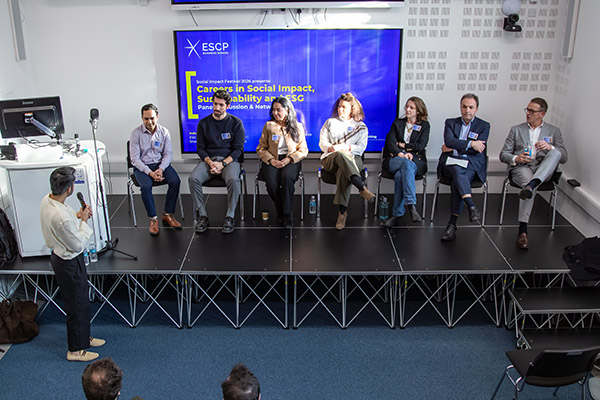
Rethinking careers through a social impact lens
That said, there is a growing link between business performance and environmental, social and governance (ESG) considerations, with clear evidence of impact-related roles expanding across all sectors. Whether in finance, consulting, NGOs, education or any other industry, professionals are increasingly expected to understand how their decisions affect wider systems and stakeholders.
The Festival encouraged participants to take a broader view of career development and see sustainability as a mindset that can be applied across functions and industries. Those seeking to advance their careers will need to spend time reflecting on their personal sense of purpose, deliberately engaging with diverse perspectives, becoming comfortable in uncomfortable environments and developing systems-thinking skills.
At the same time, organisations are at different stages of maturity when it comes to sustainability and social impact. While some embed sustainability deeply into their strategy, others continue to approach it as a reporting exercise.
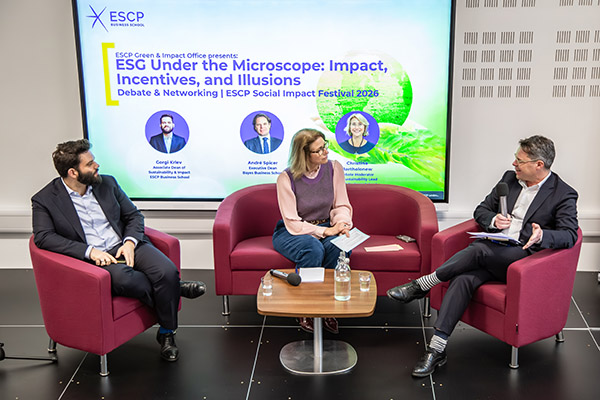
ESG under scrutiny
There needs to be a more rigorous examination of ESG. Over the past decade, it has moved into the mainstream, influencing not only reporting but also investment decisions and overall organisational strategy. Yet in a rapidly changing world, ESG’s role is becoming less clear-cut. While it aims to shift the focus from profit to broader stakeholder impact, it is increasingly questioned as to whether it delivers meaningful change or remains, in some cases, a tick-box exercise.
Organisations need to examine how impact is measured, who defines success and who bears the cost of transition, as there is always a cost. Progress will depend on stronger governance, clearer incentives, greater transparency around outcomes, and an acceptance that impact may not always align with financial returns. A more joined-up approach across business, government and education will be needed to prepare leaders who can navigate complexity and work across systems.
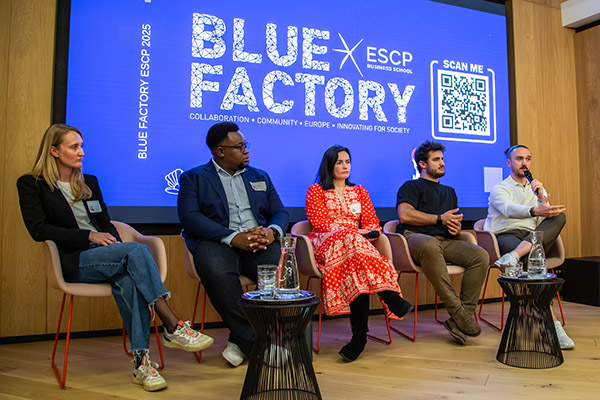
Global perspectives and emerging market opportunities
At the same time, social impact is inherently global, creating opportunities both locally and internationally, including across emerging markets. A panel discussion on scaling up Africa highlighted the continent’s rapid growth and its increasing importance within the global economy. With a projected population of 2.5 billion by 2050, Africa presents significant opportunities for investment, innovation and entrepreneurship.
While there is already a strategic shift from aid-based to investment-led models, the continent still faces challenges with access to capital and infrastructure. Thus, entrepreneurship-focused social impact should consider building more inter- and cross-continental bridges to advance the development of inclusive, locally based solutions that can scale globally. This means moving beyond isolated initiatives towards collaborative ecosystems that connect capital, talent and knowledge across the globe.
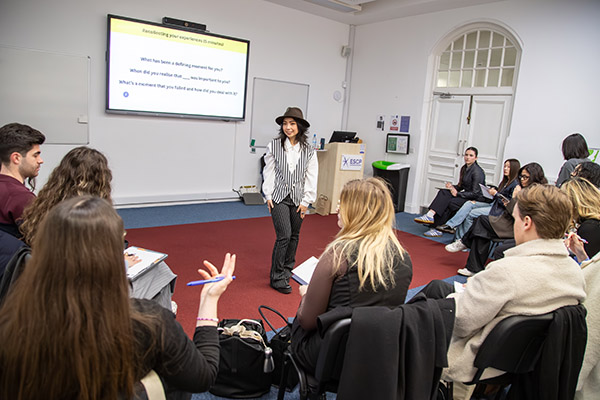
Growing through complexity, systems thinking and debate
Nobody truly likes complexity, but engaging with it is an inevitable part of making social impact a priority. The four parallel social impact hackathons demonstrated that critical thinking is a skill everyone should develop. This includes the ability to hold multiple perspectives, separate data from interpretation, and feel comfortable being wrong, changing opinions and being challenged.
The Festival aimed to build a safe space for disagreement and reflection, recognising that social impact often involves navigating trade-offs. The hackathons further reinforced this approach by challenging students to consider how decisions made in areas like marketing affect broader communities, beyond simply generating economic value for the company.
The Festival truly reshaped the way I think about leadership and the role I want to play in the future. It made me realise how easy it is to overlook the impact of what we create as marketers. I am leaving this experience with a clearer understanding that leadership is not just about ideas or ambition. It is about responsibility, intention, and the courage to act.
 Samantha Ruderman
MSc in Marketing & Creativity student
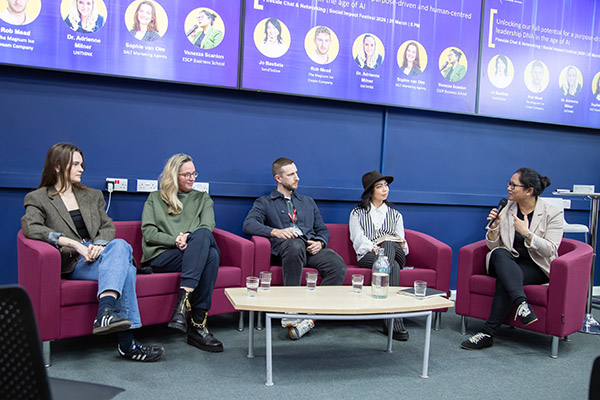
Human-centred leadership in an AI-driven world
The role of human judgement was also a recurring theme throughout the Festival. As artificial intelligence takes on a more prominent role in business processes, empathy, creativity, authentic storytelling and ethical reasoning will increasingly drive the true success of any organisation.
The job market has evolved and will continue to do so. As a result, one of the best investments you can make is in developing soft skills such as adaptability, resilience and initiative. Furthermore, the pace of change is unlikely to slow down, making it essential to rethink traditional roles and job definitions, and to take proactive ownership of challenges - even when they fall outside your formal job responsibilities.
Networking, curiosity and a willingness to be bold and step outside one’s comfort zone will be key to securing opportunities in an increasingly competitive job market. As Dr Adrienne Milner from UNTHINK said, “I like to use this quote from the Oz Principle (Connors, Smith, & Hickman, 1994): 'See it, own it, solve it, do it'. Companies want people who take ownership, are accountable, and solve rather than simply discuss problems ”. Effective leadership today — and in the years ahead — will depend on being curious, recognising what needs to be done, seeing the big picture, and acting on it. As Rob Mead from The Magnum Ice Cream Company added: "future leaders need to be boldly curious and make sure they can zoom out with the whys before zooming back in to be able to unlock and piece things together".
So, what's next?
Now in its fifth year, ESCP’s Social Impact Festival continues to evolve in response to changing global dynamics, creating a platform for dialogue and experimentation that reflects the ever-changing realities of today’s business environment.
The world will continue to be disrupted by technology, geopolitics and changing societal expectations. Yet a people-centred focus must remain at the core. The challenge now is to sharpen that focus and continue to learn, adapt, question and grow, not losing sight of what is important.
Campuses