
What does it really mean to integrate sustainability into the core of financial decision-making?
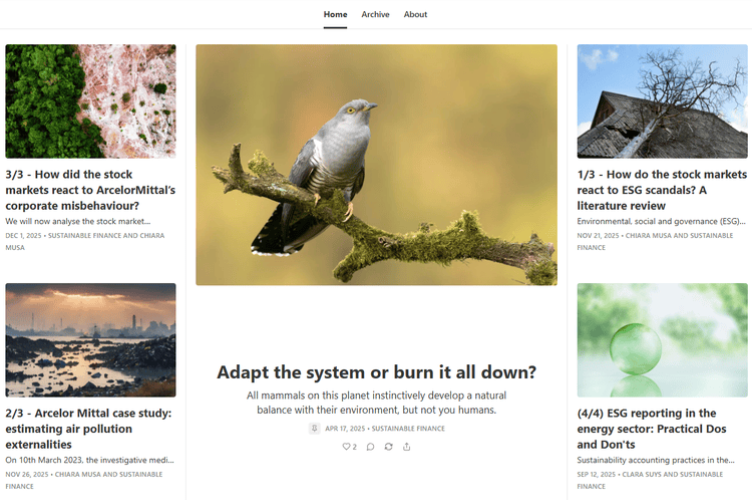
A new voice in sustainable finance is emerging from academia and corporate partnership. The Sustainable Finance Substack, created by Professor Christophe Thibierge at ESCP Business School, is a dynamic platform to explore the role of finance in addressing environmental and societal challenges.
Developed as part of the corporate initiative “The Green CFO”, in partnership with the investment fund Infranity, this Substack reflects a broader ambition: to transform corporate finance practices by integrating sustainability at their core.
From Classroom to Global Platform
This initiative is deeply rooted in ESCP’s academic ecosystem. Dr. Christophe Thibierge, Associate Professor of Finance and Scientific Director of the partnership, based the platform on the work of students enrolled in the “Green CFO” finance specialization, alongside contributions from experts and practitioners.
Professor Thibierge’s journey into sustainable finance began when he reconnected with younger students during a sustainability-focused seminar. Confronted with both the urgency of climate issues and students’ expectations, he identified a gap between traditional corporate finance teachings and the emerging sustainability agendas.
This realization led to three key convictions:
- We need to challenge the long-standing dogma of shareholder primacy
- We should embed sustainability into corporate finance decision models, not just financial markets
- Existing financial models must not be replaced, but rather, they should evolve by integrating ESG dimensions at their core
These seminal ideas led to the creation of a dedicated finance specialization (“The Green CFO / Sustainable finance”), followed by the launch of the Sustainable finance Substack, co-developed with alumni and supported by the ESCP Foundation and Infranity.
A Platform to launch and encourage Sustainable Finance Debates
How Have Risks Changed in Recent Years?
This article highlights a fundamental shift in risk perception. Risks pertaining to finance (such as financial crises) are no longer dominant; instead, environmental, societal, and geopolitical risks are becoming central, often interconnected, and systemic. Financial decision-making must therefore adapt to a world where climate and sustainability risks are no longer peripheral but core to value creation.
How Can We Spot Corporate Greenwashing?
Designed as a practical guide to identifying misleading sustainability claims, this article outlines key “red flags,” including:
- Vague or unverifiable ESG commitments
- Selective disclosure of positive data
- Misalignment between communication and actual business practices
It equips investors and stakeholders with tools to critically assess corporate sustainability narratives.
How Do Stock Markets React to Climate Announcements?
Through empirical analysis, this series of 3 articles explores how financial markets respond to climate-related news. Findings suggest that:
- Markets are reacting more and more to sustainability disclosures
- However, market reactions vary depending on credibility, timing, and perceived financial impact
- Investors are progressively integrating ESG signals into valuation, though not always consistently
ESG Reporting in the Energy Sector: Repsol vs. Saudi Aramco
This comparative study examines how two major energy players approach ESG reporting. It reveals significant disparities in transparency, metrics, and strategic alignment, illustrating broader challenges in standardizing ESG disclosures across industries and geographies.
Bridging Academia and Practice
What sets this Substack apart is its hybrid nature: it combines academic rigor, student-driven insights, and real-world applicability. By giving a platform to emerging finance professionals, it reflects the growing demand from younger generations to rethink the purpose of finance.
When sustainable finance is often reduced to products like green bonds or ESG ratings, this initiative tries to go the extra mile, by questioning how corporate financial decisions must evolve in times of growing concerns over climate change, energy transition, and stakeholder expectations.
A Growing Community of Change-Makers
With contributions ranging from students to academics and industry experts, this platform aims at building a community interested in reshaping finance from within. In a nutshell: we should not (and probably con not) discard traditional finance, but we could transform it into a tool more capable of addressing 21st-century challenges.
As sustainable finance continues to gain traction globally, platforms like this one may play a crucial role in bridging the gap between theory and practice, and in shaping the mindset of tomorrow’s financial professionals.
Campuses