
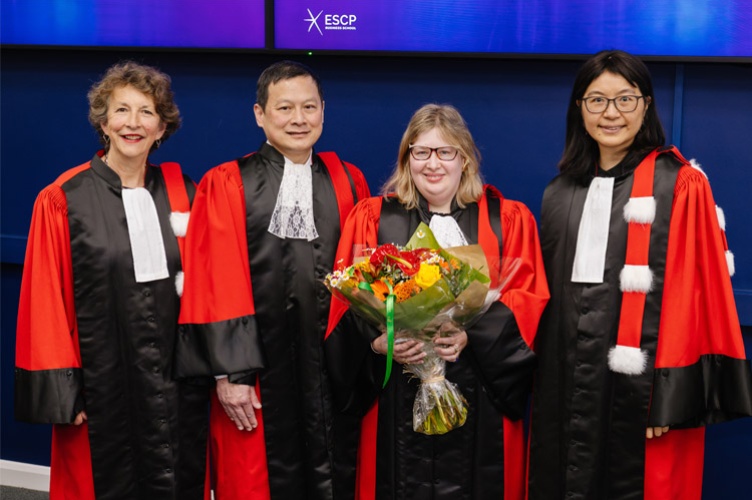
ESCP Business School celebrated Professor Chloe Preece with an inaugural lecture on creativity, culture and value in marketing.
Hosted at the London Campus on 14th May, the lecture welcomed faculty, academic co-authors, friends and past and current students to celebrate her career and appointment to the highest academic rank.
The event recognised Professor Preece's remarkable career journey and unique contribution to marketing scholarship at the intersection of creativity, culture, arts and value.
The lecture started with the opening remarks from Professor Pramuan Bunkanwanicha, Dean of Faculty at ESCP Business School, and Professor Marie Taillard, Dean of ESCP Business School London Campus, who praised Professor Preece for consistently pushing marketing beyond transactional frameworks and into broader conversations around arts, interpretation, care, creativity and human experience.
They reflected on her ability to combine academic rigour with originality in both research and teaching. Alongside her internationally recognised research, they noted her unwavering energy, openness and curiosity to experiment, from incorporating beatboxing and improvisation into teaching to her ability to translate seemingly abstract concepts into grounded research.
Chloe's inaugural speech left me genuinely in awe. What struck me most was not only the creativity of her research, but the depth of reflection and humanity behind it. In a time where academia can easily become detached and transactional, her work reminds us that research can still create connection, empathy, and meaning.
 Hsin-Hsuan Meg Lee
Associate Professor of Marketing & Head of Faculty, ESCP London
The Lecture
During the 45-minute lecture, Preece fully immersed the audience into her career journey through storytelling, humour, artistic references and even audience participation, guiding them through the core ideas that have shaped her work and research interests.
Over the course of her career, she looked into nostalgia, branding, creativity, VR, and the arts sector, exploring how meaning is created through feeling, interpretation and shared cultural understanding. Using various examples from James Bond and regressive nostalgia to art forgeries and immersive virtual futures, she challenged the audience to think differently about authenticity and value creation, as well as the stories societies choose to preserve and highlight.
Throughout the lecture, she kept returning to the deeply human impact of creativity and value creation. One that goes beyond outcomes or performance, emphasising recognition, care and the emotional connection it sparks with consumers. The lecture demonstrated that Preece's work clearly advocates a more reflective and emotionally intelligent approach to marketing that embraces ambiguity, complex interpretation and celebrates things that are sometimes not as easily seen or measured.
The evening concluded with multiple standing ovations from an audience, reflecting both the academic and personal impact Professor Preece has had throughout her career.
My inaugural lecture took the form of a small ‘choose your own adventure,’ a reflection on creativity, culture, care, and the many paths that shape an academic journey. I feel incredibly fortunate to work at ESCP, an institution that has supported experimentation in both my teaching and research, while being surrounded by colleagues, friends, and family who have helped shape the journey along the way.
 Chloe Preece
Professor of Marketing at ESCP Business School in London
About Chloe Preece's Research and Industry Contributions
Professor Preece has published extensively in leading journals, including the Journal of Consumer Research, International Journal of Research in Marketing, Annals of Tourism Research, European Journal of Marketing, Journal of Marketing Management, and Journal of Macromarketing. She co-edited Marketing the Arts (Routledge, 2023) and The Power of Consumer Creativity (Palgrave Macmillan, 2025).
She is Chair of the Arts, Heritage, Non-Profit and Social Marketing Special Interest Group of the Academy of Marketing, and also sits on the Research Committee of the Academy of Marketing and the editorial boards of Annals of Tourism Research, Journal of Marketing Management, Arts and the Market and Journal of Customer Behaviour.
Her research has been supported by the Arts and Humanities Research Council (AHRC), including the multi-million-pound StoryFutures and StoryFutures Academy projects, and by the British Academy/Leverhulme Small Research Grants scheme.

Three Questions with Chloe Preece
After the lecture, we asked Professor Chloe Preece to reflect on the moments, ideas and questions that continue to influence her work today.
1. Looking back across your career, what moment or idea most influenced the way you think about creativity, culture, and marketing today?
Chloe Preece: One of the most influential moments for me was early in my PhD, working with visual artists. I went in thinking I was studying creativity, but what I found was something quite different - that value doesn’t sit in the work itself. It is negotiated, contested, and shaped through how it is framed, recognised, and experienced.
That insight stayed with me. Whether I was studying artists, brands like James Bond, or immersive technologies, the same question kept returning: not just how value is created, but how it is made meaningful, and for whom. It also made me realise that marketing is not just a technical discipline. It is deeply cultural. It plays a role in shaping what we see, what we value, and what we overlook.
2. As AI makes its mark on content creation, how do you see the role of human storytelling and the arts changing?
CP: I don’t think AI replaces storytelling but it does change the conditions under which it happens. What we’re seeing is an increasing emphasis on speed, scale, and optimisation. AI can generate content remarkably quickly, and often convincingly. But what it struggles with is judgment: knowing what matters, what resonates, and how meaning unfolds over time. That’s where the arts remain crucial.
The arts don’t just produce stories, they reveal them. They bring forward voices, experiences, and forms of labour that are often overlooked or unheard. In that sense, they play an important role in making the invisible visible. If anything, the rise of AI makes that role more important. It shifts the focus from production to attention - to asking not just what can be generated, but what should be recognised, whose stories are being told, and whose are still missing.
3. What is one shift in marketing that excites you most as we look to the future, and why?
CP: The shift that excites me most is a growing move toward embodied and affective experience in how we understand marketing. For a long time, marketing has focused only on cognition, what people think, choose, or decide. But increasingly, we’re seeing recognition that how people feel, move, and encounter the world matters just as much.
This opens up space for approaches that draw from the arts, from performance, movement, and sensory experience. I’ve been particularly inspired by choreographer and dancer Wayne McGregor’s work on physical intelligence, which foregrounds the body as a site of knowledge, creativity, and decision-making. It offers a really powerful way of thinking beyond purely cognitive models.
What’s exciting is the possibility of moving beyond abstract, analytical understandings of value toward something more situated and lived. Not just how people interpret markets, but how they inhabit them. And that, I think, creates space for a more human, more attentive, and ultimately more meaningful form of marketing.
For more information...
Campus