
AI literacy, governance and the human skills defining leadership in an AI-shaped world
The future of work is changing as you read this, and the question is how best to prepare.
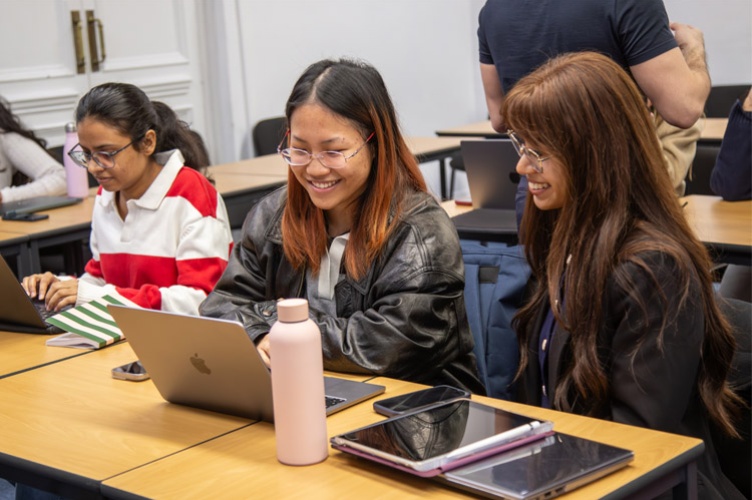
As one of Europe’s leading business schools and a key player in the UK business school landscape, ESCP London Campus hosted its first AI Day on 3 March, featuring talks and interactive sessions to co-create a roadmap for thriving across personal, educational and professional spheres in a rapidly changing world.
Organised by the London Campus AI Coordinator, Audrey Picard, the programme combined an OpenAI hackathon in the morning led by Shaig Abduragimov, Lead Solution Engineer, Education, TED talks from experts, a human intelligence quest games delivered by students, and a roundtable on Radical Futures - all of which offered glimpses into a question on everyone's mind: how do we lead in the age of Artificial Intelligence (AI)?
Dedicating one day to questioning our human relevance, or uniqueness, in the world of AI felt like an obvious step for a business school preparing the leaders of tomorrow. ESCP has been at the forefront of experimenting with AI tools in teaching and learning, at a time when many institutions were still reflecting on their approach. The next step for us was to explore how we guide our students through the transition from studying to working, helping them build the ‘Human Touch’ toolkit that will truly make a difference in recruitment and throughout their professional careers. This AI Day marks the beginning of a broader journey with further events, strengthened corporate partnerships, and continuous updates to our syllabi and curriculum design.
 Audrey Picard
London AI Coordinator
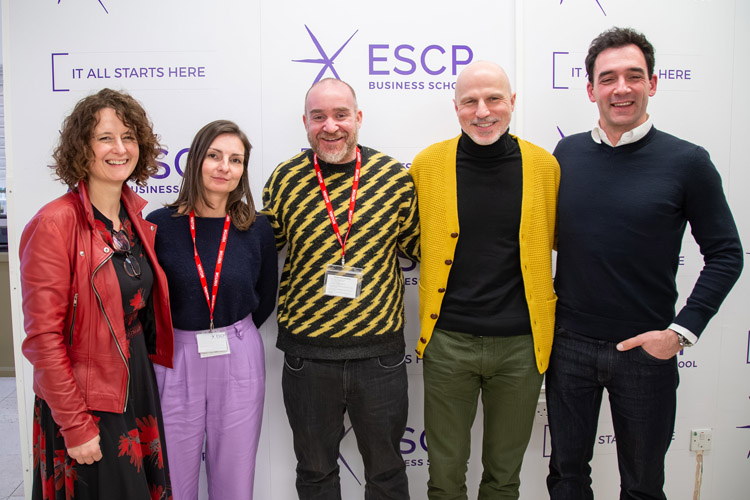
Speakers included senior voices from OpenAI, Meta, the UK Government and leading AI ventures, alongside ESCP alumni shaping the field.
Among those driving the conversation throughout the day were:
- Alessandra di Lorenzo, Speaker and Author of Adjust
- Michaelangelo Marchiorello, Head of Creator Acquisition at Meta and ESCP Class of 2014 alumnus
- Alice Ivanoff-Boardman, Co-Founder and CEO of Kokoon and ESCP Class of 2017 alumna
- Daniel Hembling, Managing Director of Guut
- Luminita Tuchel, AI and ML Workstream Lead at Humanitarian and Stabilisation Operations Team, UK Government
- Enrico Nonino, Advisor for Whype and Platinum Balloon
- Hugo Pickford-Wardle, CEO of AI Night School and founder of The AI Optimist
AI Day: Key Takeaways
All speakers and facilitators had their own unique take on what it takes to be more future-ready, but here are some takeaways we would like to share with you:
Structured delegation in the AI era
With the rise of agentic AI work, the job market is slowly shifting from "doing" skills to delegating skills. Our roles transform into assigning tasks, orchestrating execution, and adding the final human touches. Working with AI agents means it is more important than ever to communicate tasks effectively, breaking work into steps, iterating and keeping human decision checkpoints throughout. You need to know how to prompt, understand constraints, and have a clear sense of the outcome from the start. Therefore, the next essential soft skill may well be structured AI delegation, as we all become the conductors of the tech orchestra.
AI literacy is your relevance ticket
If delegation is the new skill, AI literacy becomes the essential foundation for it. AI literacy is less about understanding how AI works technically and more about using it strategically to minimise hallucinations, set the right constraints and instructions, iterate workflows, and manage context and memory.
This allows you to better access your own resources — for example, through the notion of a ‘second brain’ — and identify opportunities to automate parts of your work. Current students will be the first generation fluent in AI to enter the workplace, which presents significant advantages and will be your ticket to relevance in the job market.
Think of it in layers as you build your AI literacy infrastructure. At the base sits tool fluency. Above that are workflow design skills. Then comes critical judgement. And finally, the ability to self-regulate as the industry evolves at exponential speed.
Closing the governance gap
At the same time, we all feel that FOMO and rush to learn new tools and experiment with AI for every possible use case, including countless investors who continue to pour money into AI ventures. Sadly, this means the technology is evolving faster than governance can keep up. Realistically, regulatory capacity remains insufficient, with limited oversight layers and reduced transparency around data use, which increases potential risks.
As the world develops, the cost of doing — of producing and generating — is slowly dropping towards zero, which may mean a need for economic rebalancing. Investing in governance, regulation and cybersecurity skills is therefore one of the clearest ways individuals can close emerging skill gaps. And governance is becoming a growth industry.
Preserve your human voice
In a world where we often use AI to correct our shiny LinkedIn posts, only to have our connections react with equally AI-polished comments, it is so easy to lose your uniqueness. There is intelligence, and there is consciousness. Machines may outperform us in speed and pattern recognition, but context and judgement remain human. Continue writing, journaling, and reading books written by humans to keep honing your tone of voice.
That cognitive depth and social, contextualised intelligence are what will set you apart from others. So if you are using AI - that's good for organising your thoughts and maybe proofreading a little, but the final edit should still stay human. AI is not there to replace your thinking, but it can certainly help you navigate and categorise things more easily, collectively building that crucial systems thinking.
Seeing clearly in an AI-filtered world
Now, more than ever, it is time to become critical of everything you see around you. Predictive and ranking AI drives visibility, carefully setting the menu of information you are exposed to. AI models summarise, compress and flatten evidence, but does that mean the decision you are making is truly yours? What about what slips through the cracks?
The more diverse the sources you read and the more you engage with different perspectives, the better equipped you will be to navigate the world while remaining human. Exploration and nuance become lifelines, and skills everyone should actively invest in developing.
Where and How Humans Still Win
As execution becomes increasingly automated, AI leadership will require skills like persuasion, cross-functional collaboration, systems thinking, emotional intelligence, problem framing, listening and ‘shepherding’ groups will be what future leaders need to excel at. Their role will be to identify the real problems, distinguish and divide tasks between AI and humans, curate judgements and package outputs for people. That reasoning capacity should become a priority.
Navigating the fear-empowerment paradox
There isn’t a person alive who is fully up to date with the latest technology. No matter how experienced you are, there are simply too many new developments happening every day, every hour. Naturally, this can feel overwhelming. You may find yourself falling into the rabbit hole of AI tools, worrying about whether your role could be automated, chasing the next breakthrough, trying to become the ultimate AI trailblazer — all while navigating the very real fear of the unknown.
The tension between fear and empowerment is real. To make it more manageable, set aside structured learning time, perhaps one to two hours a day. Keep exploring different tools so you become reasonably comfortable using three to five of them, rather than putting all your eggs in one basket or slipping into complacency.
But just as importantly, protect your mental health. Take time to focus on being, not only doing. It is easy to get lost in delivering and optimising to the point where you forget about your own wellbeing. The world will not slow down, so deliberate pauses for mindfulness, reflection, or simply doing something without a clear objective will help you stay grounded.
Throughout the AI Day, I had the chance to practice technical skills in the OpenAI Hackathon, where we vibe coded agentic automations for our everyday life using Codex, and I got to reflect on key human skills we still need in a world of AI by listening to multiple inspiring speakers and leading a hands-on session challenging students to find and practice these skills myself. My biggest takeaway from this day is that the shift which awaits us goes far beyond technology. As AI reduces the cost of 'doing', my uniquely human value in the future economy shifts to 'being' because future leaders will be the ones who stay present and solve problems by focusing on the four core human skills that AI cannot replicate: analytical thinking, resilience and agility, leadership and social influence, and creative thinking.
 Caroline Saade
MSc in Digital Transformation Management & Leadership student
The future may well be radical, and the transformation is clearly no longer only technological but increasingly existential. AI is becoming a delegation engine, a perception filter, a cognitive amplifier and a governance test. It is reshaping how decisions are made, how value is created and how leadership is defined. What happens next depends entirely on how people choose to guide both humans and machines. And that work starts here.
Find out more
Media from the ESCP London AI Day 2026
Discover related programmes at ESCP London Campus
Explore how you can bridge the AI gap, strengthen your human leadership skills and prepare for the future of work:
- MSc in Digital Transformation Management & Leadership
- MSc in Economics & Policy for Business
- MSc in Marketing & Creativity
Discover more content, events and research on AI at ESCP: escp.eu/ai
Campuses