
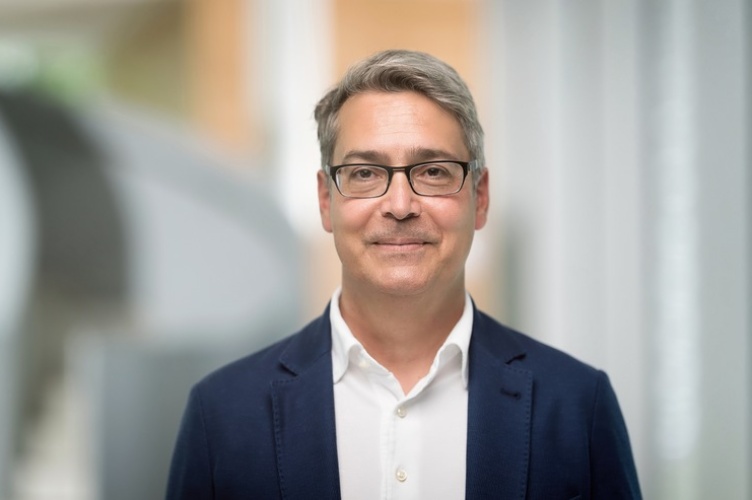
Entrepreneur Conversations at ESCP Berlin: Innovation, Purpose, and the Entrepreneurial Mindset with Marc Schurr, CEO of Ovesco
On 2 September, ESCP Berlin hosted the fifth edition of the Entrepreneur Conversations: Innovation & Beyond series, welcoming Marc Schurr, CEO of Ovesco Endoscopy. The event brought together students, alumni, and members of the wider ESCP community for an open discussion on medical innovation, leadership, international growth, and the realities of building a business in a highly regulated industry.
From medicine to entrepreneurship
Schurr’s entrepreneurial journey began in surgery and scientific research. At the time, minimally invasive surgery was emerging as a transformative field, but its development depended on new instruments and devices.
This connection between clinical challenges, scientific research, and practical innovation became the foundation of his professional life.
Today, Ovesco develops instruments for interventional endoscopy, designing procedures that can make conventional surgery unnecessary. The company manages the entire value chain, from research and development to manufacturing, logistics, and global distribution. With more than 200 employees, subsidiaries in the United States, France, and India, and products distributed in more than 70 countries, Ovesco remains international in scope while retaining what Schurr described as a startup mentality.
Innovation begins with a concrete problem
For Schurr, innovation is not about pursuing technology for its own sake. It begins with a clearly defined clinical problem and close collaboration with physicians.
Ovesco works with an international network of clinicians who contribute ideas, test prototypes, and help refine products. Schurr described this as an early form of the minimum viable product approach: developing and testing prototypes quickly, learning from practical use, and improving them through collaboration.
He also stressed that innovation does not always need to be revolutionary. Sometimes, a relatively small improvement can create significant value. He illustrated this with an optical device that makes a traditionally blind procedure visible, helping physicians carry it out more safely. The product may address a narrow clinical application, but Ovesco has become a leader in that specific subcategory.
The broader lesson was clear: meaningful innovation often comes from solving a concrete problem better than anyone else.
Leading by creating space for others
Schurr described his leadership approach as team-oriented and close to the idea of servant leadership. His role, he explained, is to help people develop their abilities and achieve more of their potential.
Rather than imposing detailed rules from the top, he prefers to give employees space to develop their own ideas and take responsibility for their work.
This approach has contributed to a strong level of employee retention, with some members of the team having worked with him for more than 20 years.
At the same time, he acknowledged that maintaining an entrepreneurial culture becomes more complex as a company grows. An organisation of 200 people requires more structure than a five-person startup, but too much bureaucracy can weaken initiative and slow down decision-making.
Growing globally while staying resilient
Ovesco’s international strategy is based on establishing a commercial presence first and then gradually building deeper local capabilities. In the United States, the company has combined market access with local manufacturing.
In India, its “local for local” approach includes producing products for the Indian market and developing stronger connections with local clinical and research communities.
Schurr argued that geopolitical uncertainty should not only be viewed as a threat. By distributing value creation across different countries, companies can reduce their exposure to tariffs and disruptions while benefiting from local expertise and clinical networks.
He also identified Asia as a major area of future growth. Although the region currently represents only a small share of Ovesco’s total revenue, Schurr sees significant opportunities in India and Southeast Asia.
Regulation, responsibility, and the future of healthcare
As a medical device company, Ovesco operates within an extensive regulatory framework. Schurr described European regulation as one of the company’s greatest challenges, particularly when approval processes become so costly and time-consuming that they slow the arrival of new products to patients.
This tension between regulation and innovation formed an important part of the discussion. While safety and quality are essential, Schurr questioned whether increasingly complex procedures always create corresponding clinical value.
Artificial intelligence was also discussed. Ovesco is already using AI in areas such as computer vision, manufacturing, and internal knowledge management. However, the company uses a secure, proprietary platform rather than public generative AI tools, ensuring that sensitive clinical and business information remains protected.
For Schurr, AI is likely to support research and remove unnecessary administrative work, but it will not replace the mechanical technologies at the heart of Ovesco’s therapeutic products. In this sense, AI is an enabling tool rather than an existential threat.
Advice for future entrepreneurs
The conversation concluded with a direct message to students and young professionals: follow what genuinely interests you, rather than designing your entire career according to a rigid strategic plan.
Schurr encouraged the audience to trust their intuition, pursue work that gives them energy, and remain open to unexpected opportunities.
His own career—from surgery and research to entrepreneurship and international leadership—illustrates the value of allowing a professional path to develop through curiosity and purpose.
The fifth edition of Entrepreneur Conversations reinforced one of the series’ central ideas: entrepreneurship is not limited to founding a company. It is a way of approaching problems, creating value, and taking responsibility for meaningful change.
Campuses