
Sustainability
News
Third Annual ESCP-UNEP Symposium on Sustainability Entrepreneurship Education takes place in Berlin
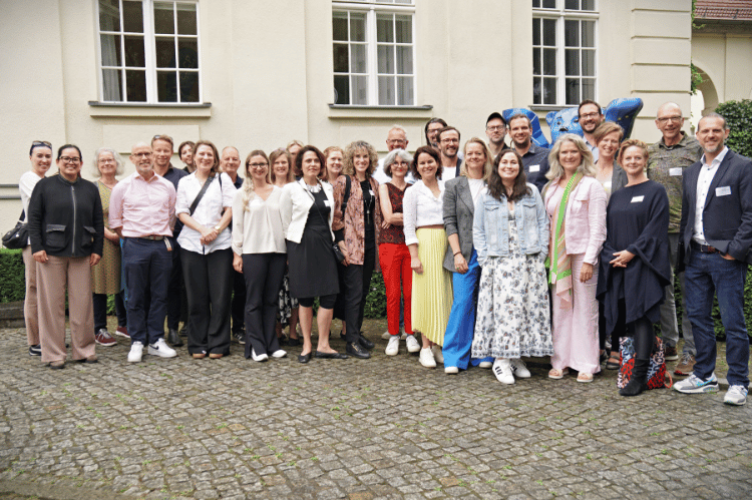
ESCP Business School and the UN Environment Programme (UNEP), in partnership with the ESCP STAR and Jean-Baptiste Say Institute, recently hosted the 3rd annual symposium on “Teaching and Curriculum Development in Sustainability Entrepreneurship” at ESCP’s campus in Berlin-Charlottenburg.
Every year, this event gathers a wide range of academic educators, sustainability practitioners, impact
entrepreneurs, experts, and students to discuss the most relevant topics in sustainability entrepreneurship
education, promoting and improving its future curriculum development.
Professors Florian Lüdeke-Freund and Robert
Sheldon, as the Academic Director and Co-Director of ESCP’s MSc in Sustainability Entrepreneurship
and Innovation (MSEI), hosted the event with Garrette E. Clark, Sustainable
Lifestyles Programme Officer at UNEP.
Over the course of two days, carefully selected and invited speakers and participants discussed the current
state of business school curricula in the emerging field of sustainability entrepreneurship. The symposium
kicked off with introductions and agenda-setting from the three hosts, while The Hot or Cool Institute's
Director, Lewis Akenji, presented a thought-provoking keynote address regarding the state of global
sustainability efforts, with a focus on social justice within the SDGs.
A highlight was the Global Business School Panel, where global leaders such as Sirasa Kantaratanakul from
Thammasat University (Thailand), Sebastián Chavez from Universidad del Rosario (Spain), Concepción Galdon
from IE Business School (Spain), and Joe Miemczyk from ESCP Business School discussed the role of
international business education in fostering sustainable entrepreneurship.
More diverse stakeholders and topics than ever before
This year’s Symposium saw a higher number of invested stakeholders than ever before, demonstrated by the
diverse roundtables that were held. These interactive roundtable sessions covered timely topics such as the
impact of generative AI on education, fostering an entrepreneurial mindset, measuring impact for
sustainable entrepreneurship curriculum development, integrating sustainability into business models, and
adapting design thinking for sustainability training. The roundtable sessions were led by participating
educators from a variety of institutions and countries (Germany, France, Spain, the Netherlands, Latin
America, and Eastern Europe), representing a great diversity of voices and perspectives. Outcomes of
discussions were shared back in the common room, benefiting all symposium participants, providing food for
thought for months to come.
Another highlight of this year’s event was the inclusion of a greater number of sustainability practitioners
and impact entrepreneurs. Alexander Piutti, founder of SPRK global, and David Löwe, co-founder of Everdrop
led a discussion on sustainable business practices in entrepreneurial ventures, emphasizing the importance
of starting out with impact business models, testing radically new ideas, and assuming a growth mindset
throughout the journey. Hege Sæbjørnsen, Global Circular Strategy Associate Director at Ingka Group, IKEA,
shed light on how sustainability-related innovation and intrapreneurship can be fostered in the context of
global conglomerates. At the panel discussion on Green Venture Financing, entrepreneurs and fund managers
such as Alexis Figeac, an eco-innovation and cleantech investor; Antoine Hubert, co-founder of Ynsect and
Till Rösnick of WEPA Ventures exchanged around the topic of sustainably finance and how the needs and
learnings of impact entrepreneurs and sustainability investors could be best translated into the classroom.
Collaboration is key to promoting and improving future curriculum development
A big takeaway every year is that collaboration is key in advancing the field of sustainability entrepreneurship. Naturally, the Symposium fosters the perfect opportunity for exchange and networking to bring about new co-operations in research, curricula, etc. The event is also one component of the on-going partnership between UNEP and ESCP, which also includes the Sustainable Lifestyles Venture (SLV), a three-term project course that allows Master in Sustainability Entrepreneurship & Innovation to develop ideas that will give consumers more sustainable choices.
Campuses