

In an era defined by polycrisis — that is, a simultaneous and interlocking swarm of global disruptions — the comforting…
10 July 2025 | 5 minute read
InsightsThe Big Question
Global business is entering a new era of structural uncertainty, shaped by geopolitical tensions, trade wars, climate risk and fragile supply chains. Members of the ESCP community consider whether globalisation is under threat and how organisations can build the resilience, agility and strategic vision needed to navigate what comes next.
6 October 2026 | 11 minute read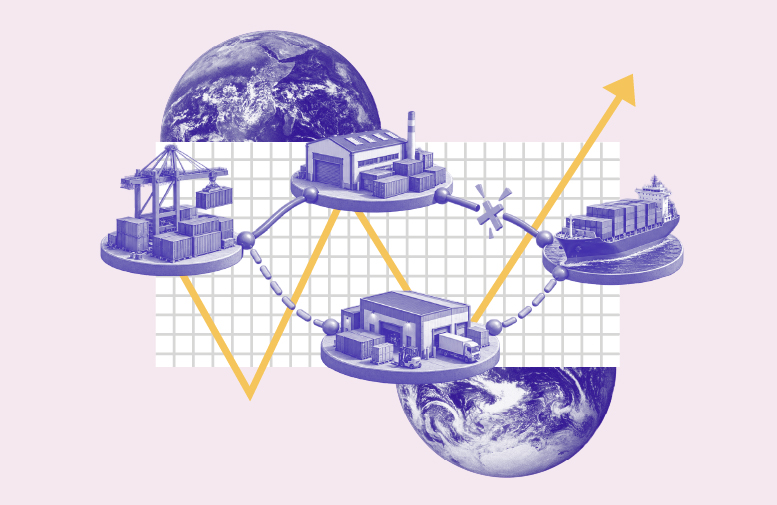
From geopolitical tension to shifting trade rules, the global business playbook is being rewritten, but what does this mean for the companies that operate across international borders? Here, voices from across the ESCP community offer their perspectives.
“The short answer is ‘yes’ – although the reality is a little more complicated. Global business is not a monolithic entity and the situation of a company and its level of vulnerability varies vastly depending on its activity and the geographical location. The economic perspectives of a business based in the European Union, for example, are very different from those in the US and China.
“This is down to a number of factors. The natural resources that are necessary to run an economy – oil, gas, iron ore and such – are almost absent in the European Union while they are abundant in the US, which leads the world in oil and gas production; and in China, which is by very far the biggest producer of coal.
“Similarly, while European industrial capacities have been decreasing for decades, China has become a manufacturing giant, boosting its production of steel, electrical batteries and vehicles, photovoltaic panels and wind turbines among many other key outputs.
“That means the European Union is far more dependent on its importation of natural resources and manufactured goods than its competitors, and this makes it more vulnerable to any instability that affects its supply.
“The exposure of a company also depends massively on its business activity: heatwaves and droughts directly affect farmers, but have very little impact on oil and gas companies. The Covid epidemic almost entirely shutdown tourism and aviation for several months, while online services benefited massively from the containment.
“The vectors of instability are numerous – technology, supply disruptions on critical resources, trade wars, military conflicts, epidemics, climate change to name a few – and business leaders don’t necessarily monitor all of them equally. While technological advances and geopolitical conflicts are tracked closely, the growing consequences of climate change are still massively overlooked.
“Furthermore, business leaders tend to analyse these vectors independently from each other, which is a mistake given that they can often interact together to impact a common economic system. Look, for instance, at the dramatic drought that dried up the Danube in eastern Europe this summer and forced several countries to stop nuclear reactors. This created an energy crisis, forcing companies to reduce their production. We know that in the future, droughts will be more frequent and more intense due to climate change.
“So, what does this all mean for business leaders? I often compare managing a company to navigating a boat at sea. In order to reach your destination, you need to respond to the wind, waves and the current, all at the same time. These are all destabilising factors that must be addressed together.
“The problem is that many companies don’t do this. They are too focused on the very short-term horizon only – meaning they don’t always look at the bigger picture or take the time to implement a more robust, long-term strategy to transform the structuring drivers of their business, supply chain and markets.
“In an unstable world, not taking this action is what really puts businesses at risk.”
“I recently read an article in a French newspaper that said the world is discovering again – with some sort of surprise – that free, easy global trade is not a given.
“I agree. Because everything is so connected now, events anywhere in the world can affect us all more than ever. When Iran closed the Strait of Hormuz, for example, they took the whole world’s economy hostage.
“A lot of my generation feel that this is unfair, because it is not the future we imagined we’d have for our careers. But I don’t really see it that way. I think about it historically. My grandparents lived during the Second World War, so I always grew up with an understanding that conflict and geopolitical tension were tangible things. Not just threats on the horizon. This is why, I think, when instability started to arise, I wasn’t that unsettled – letting go of the idea of living in a forever safe world wasn’t such a painful process.
“In fact, the economic golden age that occurred after the war, where profitability became the premier objective and this held everything together, seems far more unusual. We got lucky for about 50 years, but now it has stopped. I think the world will become increasingly unstable. The house of cards – which was reliant on every player working together and focusing on profit – is collapsing.
“That shapes how I see the future very directly. If you had asked me a year ago, I would have said I could pursue work anywhere I wanted. Now geography feels much less certain. I want to work in the Middle East, but today I factor in questions that I would not have asked before: what region is stable enough, could I be forced out because of an imminent war? Before, you only asked those questions about a few places. Now it feels like you ask them almost everywhere.
“I think this proves that globalisation is not a utopia. It has its problems. I know I’m in the minority among my peers with this view. A lot of the people I know are in finance, or related fields, and they still tend to see things in terms of economic profitability. There is still this idea that profitability comes from a completely globalised trade, where you produce in the cheapest countries and sell in the most expensive ones. This outlook is obviously seductive, but now we’re seeing that global trade is not only risky geopolitically, but also dangerous ecologically.
“I think we went too far, too quickly, into globalisation. We forgot that individual communities exist for a reason. Maybe there is a richness in that that we tried to erase. Perhaps we need a system that is a little more local and less contingent on global events. We went too far on one side, and now we are going too far on the other with so much protectionism and tariffs. If there is a middle ground, we need to find it.”
“In the last ten years, we’ve seen a huge amount of instability and global businesses have had to evolve extremely rapidly, particularly with regard to their supply chains.
“After decades of relative stability, when having a global supply network offered a major competitive advantage in terms of cost efficiency, the whole economic model came under pressure – first with rising trade tensions in the late 2010s, then with COVID.
“Suddenly, factories closed, ports were blocked and freight costs soared. The advantage moved to the businesses that were most resilient, the ones that could continue to source, manufacture, ship, and stay on shelf.
“Which brings us to the most recent phase of global business, where uncertainty has become structural. It’s now baked into the system with the arrival of numerous geopolitical shocks, all the regulatory divergence between regions, and, of course, the ongoing trade wars.
“As a result, the real competitive advantage today is agility – not simply reacting quickly, but building optionality in advance: having alternative suppliers, materials, manufacturing capacity or logistics routes that allow you to react when the next shock comes, because it will for all global businesses.
“Global supply chains are particularly exposed because the specialisation and economies of scale that create the benefits of globalisation also create dependencies. And any dependency may become a vulnerability.
“I remember the morning after Liberation Day clearly. The first question on everyone’s mind was simple: what’s our exposure now? Trump had announced sweeping new tariffs, and suddenly we needed to know our number. But the real exercise wasn’t responding to that day’s announcement, which would change repeatedly. It was mapping and digitising our supply chain dependencies so we could respond to whatever came next, and build optionality where our competitive edge was at risk.
“Knowing your supply chain sounds obvious, but it’s hard. You might know who you buy from, but do you know who your suppliers buy from?
“But that doesn’t mean being global is a mistake. The WTO’s latest report illustrates the value embedded in global trade: by 2050, strengthened multilateral cooperation could raise global GDP by 2.9 percent, while fragmentation into geopolitical blocs could reduce it by 5 percent. Global integration remains a powerful source of value. And with global scale comes responsibility: international trade can – and should – also be a force for good, helping to raise social and environmental standards across global value chains.
“Regulation is part of that picture, and it cuts both ways. On one hand, it’s a source of disruption. Europe is a huge rule-setter, and companies operating here face constraints that competitors elsewhere may not – for example around packaging materials or certain chemicals.
“On the other hand, regulation can drive innovation while levelling the playing field so responsible companies are not disadvantaged by the costs involved. Regulation can help create an economic model that is sustainable, while driving capabilities in areas such as traceability, packaging redesign and material substitution, that could become a competitive advantage as similar standards expand elsewhere.
“So no, I don’t think global business is under threat. But the model must keep evolving. Companies that use every shock to better understand their dependencies, strengthen their data and build more resilient, responsible and adaptable supply chains will be better equipped for what comes next – and they will be a powerful source of innovation, helping to develop and scale solutions to global challenges that will benefit everyone.”
“Is global business under threat? I would say yes, in the sense that many businesses were built in a world where stability was taken for granted. Today, that is no longer the case. We have entered a new operating environment in which permanent crisis constitutes the everyday ecosystem.
“For global companies – and for leaders – that is a major challenge. In such a context, the most decisive dimension is now organisational: the ability to evolve, adapt and transform is what will set them apart. Transformation is no longer a destination. We will always be in the middle of the river. That means what matters most is not the plan itself, but the capacity to steer transformation with leadership and vision.
“An understanding of geopolitics is now also essential for global business, which is why many big companies are creating geopolitical officer roles at board level. This is also why geopolitics is now a significant part of what we teach at ESCP, as we prepare the next generation of leaders. Higher Education needs hybridisation today, and the recent creation of ESCP School Technology is also a good example.
“As the major geopolitical blocs fragment, businesses are facing new challenges. Take compliance. You may be in charge of compliance in a big company, expected to work very hard on international standards, constraints and laws. But at the same time, you receive political guidance saying national laws are the priority, that sovereignty must be strengthened, that some constraints should be lifted because competitors are less constrained. At the end of the value chain, companies have to manage that contradiction. And it is very difficult.
“The UAE is an interesting example. Its whole model was built on confidence, security and stability. In the global picture, it was probably one of the most peaceful and secure environments for business, finance and tourism. Then came the shock of February 2026. But what is striking is that the response has not been retreat. The UAE has shown strong resilience capabilities and has continued to invest in technology and in its long-term vision even during a critical period. I think it is drawing two lessons from the crisis: first, that organisational resilience must be strengthened; and second, that sovereignty has become a national priority.
“But sovereignty does not mean isolation. I think the UAE is re-establishing local and regional links while also diversifying its global alliances. In that sense, instability may push it to think both more locally and more globally at the same time. That, to me, is the real challenge for global business today: finding the strategic point between sovereignty and interdependence.”
The views and opinions expressed in this piece are purely those of the authors.
In an era defined by polycrisis — that is, a simultaneous and interlocking swarm of global disruptions — the comforting…
10 July 2025 | 5 minute read
Insights
The European Union set out to make itself the global home of “trustworthy AI”, building the world’s first comprehensive rulebook…
26 March 2026 | 5 minute read
Insights
For decades, space belonged to large national agencies and a select few industrialists. Projects, financed by colossal public budgets, were…
8 January 2026 | 6 minute read
Insights