

As roles merge and industries overlap, value is shifting from specialisation to connection. Philosopher Gabrielle Halpern explains why hybridisation is…
9 April 2026 | 5 minute read
InsightsThe Archive
Often overlooked by the leadership playbooks, soft skills are now essential currency for the modern leader – and being funny, it turns out, is part of the story.
14 November 2024 | 6 minute read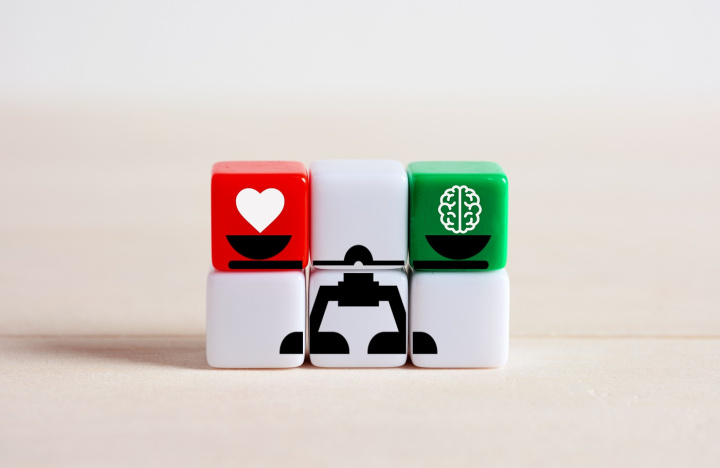
Key takeaways
At a time when AI is setting the agenda, the smart move for leaders is to enhance their technical, digital or strategic capabilities. The hard skills: the proven, needle-shifting expertise that can transform a career – or an organisation.
But according to recent research, the really smart move is to hone your soft skills. Adaptability, critical thinking, emotional intelligence and even humour are in high demand in 2026, according to organisations such as the European Labour Authority, and they’re the uniquely human qualities that can help you stand out from the crowd.
In the 1990s, soft skills entered the business lexicon with a popular book: Emotional Intelligence by Daniel Goleman. Today, these “human” skills — communication, adaptability, self-awareness, empathy — are no longer “soft” add-ons to technical expertise. They’re critical for navigating the dynamic, people-driven work environments we operate in.
But how do we define soft skills, and how can we upskill them to meet the demands of the modern workplace? To dive deeper, we spoke with Chiara Succi, associate professor of organisational behaviour at ESCP, whose research and insights shed light on these often underexplored areas of professional development.
Soft skills have become indispensable given the complexity of today’s workplace and the need to engage with diverse people professionally.

“Soft skills have become indispensable given the complexity of today’s workplace and the need to engage with diverse people professionally,” Succi begins. “Unlike the past, where we might encounter new people infrequently, today’s roles are marked by regular exposure to diverse perspectives and contexts, which demands both emotional and cultural intelligence.”
Succi explains that as technology and global connections accelerate, the need for emotional intelligence has grown proportionally. Today, it’s viewed as a critical skill for the deployment of AI tools, for example, which can often come with ethical and human considerations. A March 2026 Ipsos study (Making AI Work for Europe) notes: “individuals within businesses must ask practical questions about how ready they are to use [AI]: do they possess the technical expertise to deploy AI tools, the complementary soft skills to interpret its outputs?”
One of the challenges around the validation of soft skills is measurement. “Typically, we want to quantify everything in business to validate decisions,” Succi notes. “But soft skills are more intangible, demanding a qualitative approach to truly gauge their impact.”
Succi points to Humor, Seriously: Why Humor Is a Secret Weapon in Business and Life, a book by Jennifer Aaker and Naomi Bagdonas as a great example of how qualitative tools can measure soft skills in action.
The authors’ findings highlight humour’s powerful role in leadership and creativity, confirming what many leaders intuitively know: a well-timed joke or an empathetic connection often outshines technical expertise in generating trust, collaboration and even innovative thinking.
This shift in perspective also extends to how businesses evaluate success. Traditional metrics like productivity or profitability are now supplemented by the “softer” measures of team cohesion, creativity and employee satisfaction — indicators that often correlate strongly with a high-performing organisation.
The business case for soft skills in European business, particularly, is hard to ignore. LinkedIn’s annual Skills on the Rise report highlights the fastest-growing skills that professionals should be investing in to get ahead. And the 2026 data emphasises that soft skills are part of the modern leadership toolkit.
“Cross-functional collaboration, relationship management and coaching & mentoring” are in demand in the Netherlands, for example, while soft skills are particularly valued in Italy, where, “Clear communication, active listening and collaborative problem-solving are more critical than ever as teams become more global and cross-functional. Professionals with these skills play a key role in improving business outcomes,” says the report.
Are soft skills inherent or can they be learned? According to Succi, it’s a balanced blend: “Fifty-fifty,” she shares. “Some human skills are innate and shaped by early experiences, yet they’re also absolutely modifiable. The most important skill to nurture — and one that’s readily teachable — is self-awareness.”
Developing self-awareness is a gradual process of tuning in to one’s preferences, strengths and areas for growth, she explains. Simple actions, like reflecting on feedback, keeping a journal (observing ourselves in action), or setting specific goals for personal growth, can contribute significantly to building self-awareness.
From there, communication and emotional intelligence often follow; self-aware individuals are more attuned to others’ perspectives, making it easier to engage meaningfully in a collaborative environment.
[Soft skills] are the cornerstone of career growth in a world increasingly dominated by artificial intelligence. Robots may bring speed and precision, but we, as humans, bring imagination, intuition and affection.
With the rise of remote work, new soft skills have taken centre stage. Succi notes that remote work has amplified the need for digital communication skills, as well as digital etiquette and self-motivation. So in a setting where face-to-face cues are limited, communication has become more nuanced, requiring a heightened level of clarity, respect for digital boundaries and self-management.
Additionally, adaptability — already a core soft skill — has become even more critical, Succi adds. Professionals must not only adapt to evolving roles and responsibilities but to an entirely new mode of working, where flexibility and digital fluency are non-negotiable.
But one of the most significant changes Succi highlights is the shift in responsibility for soft skills development. “Employers no longer feel responsible for developing these skills,” she says. “They expect employees to take ownership of their personal and professional growth, even while working intense hours.”
This trend has placed the onus on individuals to pursue self-driven learning and upskilling, whether through workshops, online courses or networking. For today’s professionals, this means taking proactive steps to invest in their growth and embracing the reality that self-development is essential to career advancement.
Yet, a major barrier to that are the myths around soft skills. Perhaps the biggest misconception, Succi argues, is the very label “soft”. “Calling them ‘soft’ undermines their value,” she explains. “These skills are the cornerstone of career growth in a world increasingly dominated by artificial intelligence. Technology may bring speed and precision, but we, as humans, bring imagination, intuition and affection.”
Or put another way: “If robots bring the muscle, let humans bring the heart.”
This article was updated in October, 2026.
As roles merge and industries overlap, value is shifting from specialisation to connection. Philosopher Gabrielle Halpern explains why hybridisation is…
9 April 2026 | 5 minute read
Insights
In workplaces around the globe, a question that once felt theoretical for many professionals is now becoming harder to ignore:…
12 March 2026 | 5 minute read
Insights
In every situation, when there is a problem or an opportunity, someone must decide on several possible actions. In a…
27 June 2024 | 5 minute read
Insights