

The European Union set out to make itself the global home of “trustworthy AI”, building the world’s first comprehensive rulebook…
26 March 2026 | 5 minute read
InsightsWhile research indicates the importance of the execution side of innovation, it is rather silent on how to make innovation work in a highly regulated landscape amidst transition.
27 March 2024 | 7 minute read
Innovation has become a cornerstone for many organisations’ strategies. This is particularly evident in corporations navigating significant transitions, such as the transition of an entire country to a new energy mix, or, in the case of the Netherlands, the shift to a complete new pension system. However, in order to unlock the full potential of innovation as a strategic lever in these periods of transition, we need to understand how to actually make innovation happen.
Research on the execution side of innovation has shown that the real innovation challenge goes beyond the idea. It lies in a long, arduous journey – from imagination to impact. If you lead an innovation initiative, you must address the fundamental incompatibilities between ongoing operations and innovation by thinking differently about how you organise and how you plan.
While research indicates the importance of the execution side of innovation, it is rather silent on how to make innovation work in a highly regulated landscape amidst transition.
To find out how innovation can be a strategic lever in this context, we (a European Digital Transformation firm) conducted a consultancy project with a leading pension provider (let’s call them “The Firm” to assure anonymity) that is familiar with running innovation activities in a highly regulated landscape. Below are some of our findings and practical examples from the field.
Myth: Innovation is all about ideas. Truth: Ideas are only beginnings.
Focused on improving digital customer services and the customer experience, the transition to a new pension system is a historical step for the Dutch pension sector. All parties are depending on innovation to be the accelerator and enabler in this process. The question however is: how can they innovate to truly make an impact on customer services, marketing and communication, while staying aligned with clear regulatory requirements? The Firm turned to us to help ensure that their innovation budget is allocated as effectively as possible to meet this goal.
Our mission was clear: we needed to develop and design a working method based on existing processes that helps the Firm move effectively from innovation to realisation.
For this project, we followed a so-called consultancy design approach, e.g. a four-step methodological approach: 1) analyse the problem 2) design the solution 3) plan and 4) implement the solution, and started with an in-depth analysis that included over 15 qualitative interviews with several department representatives from across the Firm (including strategic innovation and ventures, product & channel management, client experience and business improvement and change departments).
The analysis showed a general perception that innovation can and should contribute to fulfilling the strategic pillars of the Firm. There is a belief that innovation can serve as an accelerator in the transition to the new system in the short term and also play an important role after the transition. While there are quite a few things that go well in the existing innovation process (e.g. high-quality experiments, experiments in line with the strategy and innovation vision), the analysis concluded that there are several opportunities for improvement to move from innovation to execution more effectively.
Innovation is the ability to see change as an opportunity–not a threat.
Steve Jobs
Myth: Everyone can be an innovator.
Truth: Ideation is everyone’s job, as are small improvements in each employee’s direct sphere of responsibility.
Once we uncovered the barriers in the innovation process, the next step was to define potential solutions. Based on the insights listed above, a total of nine solutions were defined to successfully make innovation happen. These solutions resulted in a strengthened working method with three key areas for improvement to achieve the greatest impact:
Operating in strictly regulated markets demands additional attention. Beyond the typical assessments in the innovation phase, the “GAP” necessitates a thorough evaluation of legal, compliance, and risk aspects. While an experiment validates an idea, a POC/MVP must meet all internal and external requirements and policies.
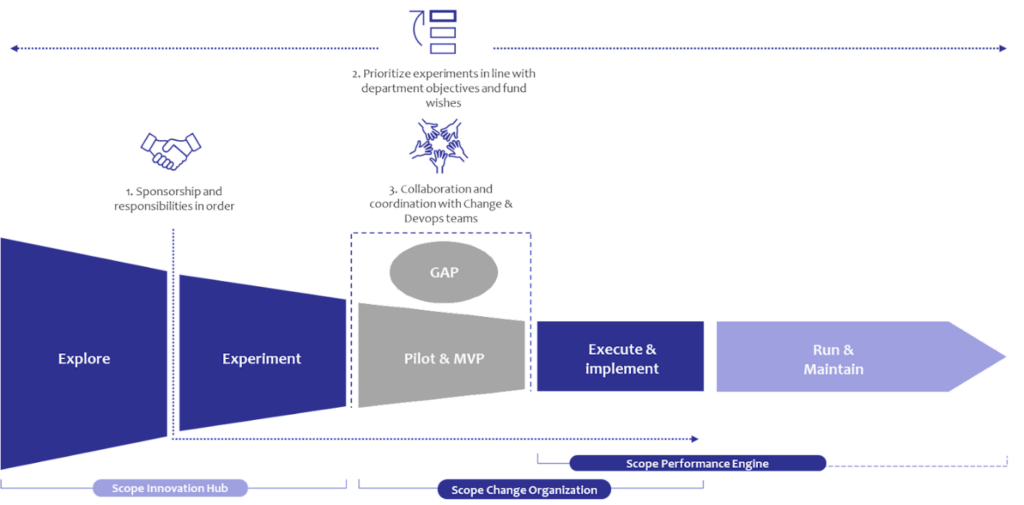
Innovation is an ongoing process. After establishing your working method, put it to the test. Execute experiments, learn from them, and adapt your approach as needed. A structured assessment of your innovation funnel can further refine your process.
We evaluated our experiments against multiple criteria, focusing on three key solution directions. This identified areas for improvement, such as delays in securing sponsors. By addressing these bottlenecks through early discussions, we can strengthen our innovation engine and transform ideas into tangible results.
As mentioned in the beginning, when you lead an innovation initiative, you must address the fundamental incompatibilities between ongoing operations and innovation by thinking differently about how you organise and how you plan. Research, however, as well as our findings also show that to innovate successfully, you must build a team with a custom organisational model and craft a plan that is only revised through a rigorous learning process (e.g. run a disciplined experiment). If you do both, you will fare much better. And if you succeed, you will move on and move up.
Myth: Innovation can only happen in skunkworks.
Truth: Innovation cannot be isolated from ongoing operations. There must be engagement between the two.
In conclusion, it is evident that highly regulated companies facing significant challenges, such as those in the pension sector, must embrace innovation as a critical lever to achieve their strategic objectives. The traditional approaches are no longer sustainable in the face of evolving regulatory landscapes and complex change. By adopting innovative strategies tailored to their specific context and challenges, these companies can effectively navigate transitions and realise their goals.
It is essential to recognise that successful innovation requires more than just clear sponsorship and defined responsibilities; it necessitates thorough research and a customized approach that aligns with the company’s unique circumstances. If approached this way, innovation serves as a powerful accelerator for driving strategic success, positioning these companies for resilience and growth in dynamic regulatory environments.
The European Union set out to make itself the global home of “trustworthy AI”, building the world’s first comprehensive rulebook…
26 March 2026 | 5 minute read
Insights
For decades, space belonged to large national agencies and a select few industrialists. Projects, financed by colossal public budgets, were…
8 January 2026 | 6 minute read
Insights
Despite record growth in renewables, oil remains the world’s single largest energy source, fueling transportation, manufacturing and petrochemicals, among others. …
25 September 2025 | 5 minute read
The Salon