
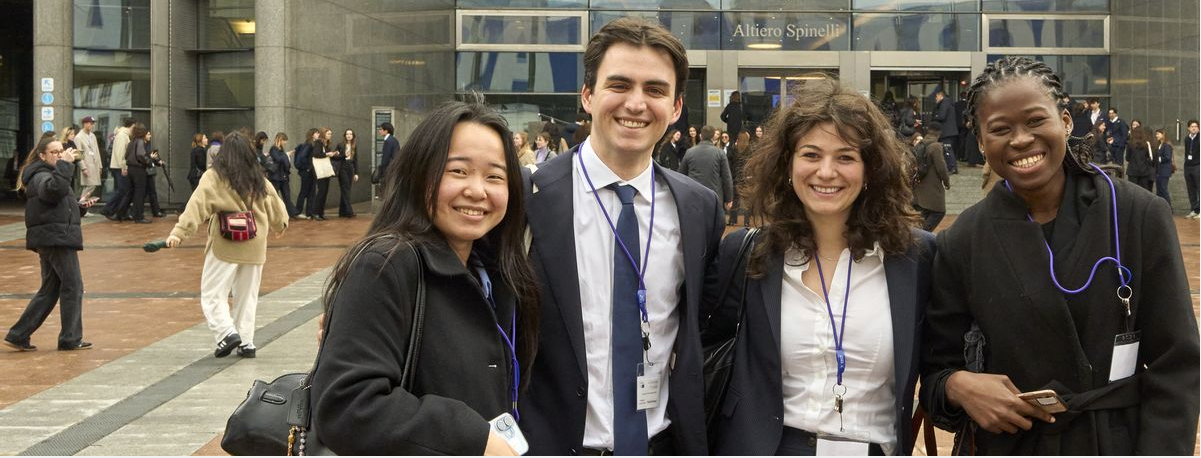
Each year, something remarkable happens within ESCP’s Master in Management (MiM): more than 1,300 students, usually scattered across campuses and countries, converge for a single, defining experience: Designing Europe. More than just a seminar, it is an immersive, large-scale simulation of the European Parliament, where students step into the roles of Members of the European Parliament (MEPs) and key stakeholders. Each participant embodies a real figure, defending their values, priorities, and political positions with rigour and conviction.
In a programme defined by constant movement, new cities, and ever-changing peer groups, this moment of convergence feels different: bigger, more intense, and deeply unifying. Foster Ng, currently studying on the Paris campus, captures this shift: “You spend a lot of time moving between cities and meeting different groups of people. This is the first time you really see the full scale of the MiM cohort in one place.”
What emerges is not just a gathering, but a shared experience that many describe as one of the most memorable moments of the programme.
Inside the European Parliament
The setting itself immediately sets the tone. Designing Europe takes place within the European Parliament, granting ESCP students access to one of the most symbolic and tightly controlled spaces in European democracy: the hemicycle.
For most, it is the first, and perhaps only, time in this chamber where history is written through debate and decision-making. The atmosphere is striking: the scale of the room, the weight of its purpose, and the awareness of stepping into the shoes of real policymakers all combine to create a powerful sense of occasion.

“It’s one thing to learn about how the EU works,” student Antonia Kleffmann, who hails from Germany, reflects. “It’s different when you’re actually sitting in the room where those decisions are made, debating and voting as if you were an MEP.”
As students take their seats, speak at the podium, and cast their votes, the simulation stops feeling like an exercise and begins to feel real. The institutional setting transforms abstract concepts into lived experience, grounding every discussion in a tangible and unforgettable context.
Connecting Business and European Policy
At its core, Designing Europe is not only about politics, it is about understanding the deep and often complex relationship between European policymaking and the business world.
Through committee sessions, negotiations, and debates, students tackle pressing issues such as economic competitiveness, sustainability, and technological transformation. These are not hypothetical topics, but real challenges currently shaping the European agenda and, by extension, the environment in which companies operate.
As discussions unfold, the connections between regulation, innovation, and strategy become increasingly clear. “You realise that regulation, trade, and innovation are all connected,” Madrid campus student Maxim Baumgaertel explains. “It’s not just theory. It affects how companies actually operate.”
By engaging directly with these questions in the very place where such policies are debated, students gain more than knowledge: they develop a sharper, more nuanced perspective on how business decisions and public policy continuously influence one another.
Bringing the Cohort Together
Beyond the academic and institutional dimensions, Designing Europe is also a rare and powerful moment of reconnection.
The MiM experience is inherently international, but its multi-campus structure often means that friendships are formed and then dispersed across cities. This seminar reverses that dynamic, bringing everyone back together in a way that feels both energising and deeply personal.
Laura Oliveira, currently studying in Berlin, reflects on this aspect: “I was able to catch up with classmates from last semester who had gone on to another campus. You also suddenly meet people from other cities you’ve only heard about from friends. It makes me feel much more connected to the entire community.”
Corridors, committee rooms, and informal gatherings buzz with conversations: old friendships rekindled, new ones formed, and a growing sense of belonging to something larger than any single campus. The diversity of the cohort becomes fully visible, not just as a concept, but as a lived reality.
A Moment of Personal Challenge
Amid the scale and excitement, Designing Europe also creates deeply personal moments and instances where students confront their limits and push beyond them.
The simulation demands active participation: speaking up, negotiating, persuading, and sometimes leading. These are not passive exercises but real tests of confidence, adaptability, and resilience.
During a recent simulation, one student chose to push herself to the limit by volunteering for the role of party president. “I’ve always been uncomfortable speaking in front of people,” Albane Théaud later admitted. “That’s exactly why I signed up to be party president.”
Standing at the podium in the hemicycle, facing hundreds of fellow students and ESCP Leadership including Executive President and Dean Léon Laulusa, the challenge became tangible.

“I was nervous the entire time,” Albane said. “My hands were shaking so much my speech was hard to read. But I kept looking at my friends in the front rows which gave me the reassurance I needed to keep going.”
It is in these moments – intense, uncomfortable, but ultimately empowering – that the experience leaves a lasting mark.
A Defining Experience of the Master in Management
Designing Europe stands apart because it brings together, in a single experience, elements that are usually encountered separately: rigorous academic exploration, direct exposure to European institutions, and the collective energy of an entire cohort.
The combination is rare. The impact is lasting.
From stepping into the hemicycle to debating real-world issues, from reconnecting with peers to overcoming personal challenges, the seminar captures something essential about the ESCP experience: its European identity, its emphasis on learning by doing, and its ability to transform perspectives.
As Foster Ng summarises: “It’s not just about understanding Europe, it’s about experiencing it, together.”
And it is precisely this shared, immersive, and unforgettable dimension that makes Designing Europe not just a component of the Master in Management, but one of its defining moments.
Hear more of what the students had to say about the 2026 edition in this Group Chat.
