
Artificial intelligence is redesigning the world of business at an extraordinary speed. New tools emerge almost weekly, companies are redesigning the way they work, and graduates are entering a job market where AI is no longer a novelty but an everyday reality. Amid all this change, however, one question matters more than any other: what does it really mean to be AI-ready?
For Professor Alara Tascioglu, Assistant Professor of Business Analytics, AI, and Digital Transformation at ESCP Business School and AI Initiative Paris Campus Coordinator, the answer has surprisingly little to do with becoming a programmer. Through AI for Big Data Management, the second-year Bachelor in Management (BSc) course she designed and leads, taught across the Paris, Madrid, and Turin campuses, she aims not simply to introduce students to the latest technologies, but to help them develop something considerably more valuable: the confidence to understand, question and direct AI in purposeful ways.
Each spring, around 1,000 second-year students take part in the course. Some arrive already experimenting with AI in their personal projects. Others quietly believe they are “not technical enough” to succeed. Yet by the end of the semester, they are building AI agents, measuring their performance and debating the choices behind the systems they have created. That transformation, Professor Tascioglu explains, is the part of teaching she cares about most. Watching students move from “I’m not a coder” to confidently saying, “Here is the system I built and here is why I built it this way,” is, for her, where the real learning happens.

Learning by Building, Not by Keeping Up
Business analytics and data science are often regarded as intimidating subjects, especially for students without technical backgrounds. Professor Tascioglu was determined to change that first impression.
Rather than presenting AI through traditional lectures or abstract theory, she deliberately designed the course to teach AI with AI itself. The technologies students are learning about become the very tools they use to learn. Business analytics and data science are introduced through gamified challenges, practical case studies and real-life scenarios that encourage experimentation rather than passive learning.
The ambition extends well beyond teaching students how to use today’s most popular platforms. By the end of the course, they should be able to use AI tools effectively, question the quality of their outputs, and even build small systems of their own.
After all, there is a significant difference between having tried ChatGPT a few times and understanding how artificial intelligence can help solve an authentic business problem. Filling that gap is exactly what the course is designed to achieve, and it leads directly to the next fundamental step: knowing when not to use AI.
The real challenge isn’t using AI. It’s knowing when not to
Picture beginning your first internship.
You are asked to prepare a competitor analysis, and an AI assistant produces a polished report in less than thirty seconds. It looks convincing. It sounds professional. It even includes charts and recommendations.
Would you send it to your manager?
Professor Tascioglu believes this is where the real work begins.
She argues that today’s professionals are no longer valued simply for producing answers. Their responsibility is to decide which tools deserve their trust, how much autonomy to give an AI system, and whether its conclusions actually stand up to scrutiny before they inform business decisions. That shift in responsibility is already becoming essential across industries.
Marketing teams use generative AI to develop customer segmentation, HR departments increasingly work alongside AI-assisted recruitment tools, and consultants rely on language models to draft analyses before refining them. In every case, technology can accelerate the process, but human judgement remains irreplaceable.
“I expect management graduates will increasingly be evaluated on a newer skill: the ability to direct AI systems well.”
A classroom that feels more like a laboratory
Step inside one of Professor Tascioglu’s classes and you will not find students spending hours listening to lectures.
Instead, laptops are opened almost immediately.
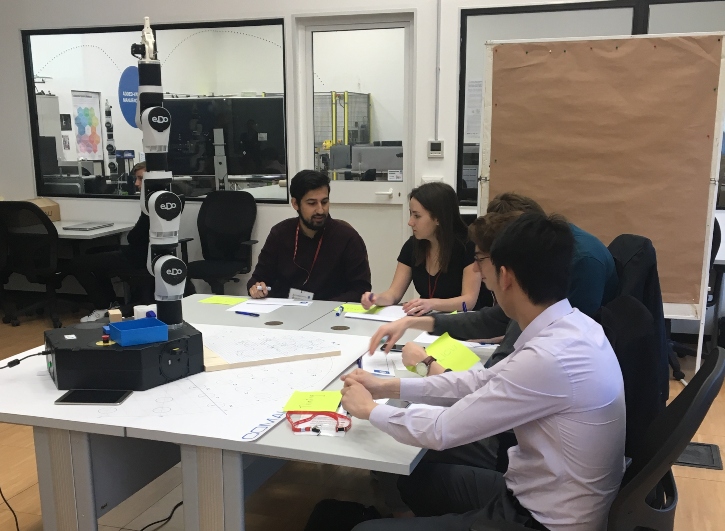
Across five sessions, students tackle three increasingly sophisticated business cases before completing a final group project in which they build, stress-test, and recommend an AI system of their own. Short theoretical introductions quickly give way to hands-on workshops, and as the semester advances, building, testing and refining become the centre of the learning experience.
The course itself is rebuilt every year. Professor Tascioglu calls it a just-in-time curriculum: a stable backbone of learning progression and assessment, with tools, platforms and case studies rebuilt annually.
When one thousand students become one research team
Perhaps the clearest illustration of this philosophy is one of the course’s most ambitious projects.
In the 2025-26 edition, students were asked to develop an AI agent for a fictional sustainable fashion company overwhelmed by customer service emails. Using different no-code platforms, each student creates a system capable of classifying incoming messages, assigning urgency levels and drafting responses in the company’s tone of voice.
At first, it appears to be an individual assignment.
It is anything but.
Every student’s results are combined into a shared dataset spanning the Paris, Madrid and Turin campuses. Suddenly, each student moves from being an AI builder to a business analyst, using Python to explore patterns across about 1,000 different AI systems.
Which platforms classify emails most accurately?
Which consume more resources, and which offer the best balance between efficiency, transparency and sustainability?
Perhaps the most interesting question, however, is this: what happens when the data proves your early assumptions wrong?
Professor Tascioglu believes this is where students gain some of their most meaningful learning experiences. Rather than defending the platform they personally preferred, they must formulate evidence-based recommendations using data generated collectively by the entire class, even when that evidence challenges their own expectations.
There is no such thing as the ‘typical’ student
Every cohort brings together students with remarkably different levels of confidence.
Some have already experimented with AI agents before arriving at ESCP. Others have never opened Google Colab or written a single line of code.
Instead of treating those differences as a problem, the course turns them into an opportunity. That approach carries into the way the class is organised. Every exercise includes a core version that everyone can complete, along with optional extensions for more experienced students. Outside the classroom, students can revisit concepts through asynchronous learning materials and interact with custom AI teaching assistants developed specifically for the course.
This variety of starting points and learning approaches is one of the classroom’s greatest strengths. More experienced students are encouraged to articulate the reasoning behind their choices, while those with less experience gradually realise that success has far less to do with technical expertise than with a spirit of inquiry, experimentation and learning from one another.
Beyond the hype
Artificial intelligence often inspires extreme reactions.
Some people see it almost as magic. Others fear it will replace entire professions.
Professor Tascioglu believes that both perspectives oversimplify reality. Once students begin designing, testing and occasionally breaking AI systems themselves, they discover that these technologies are neither magical nor all-powerful. They are tools with impressive capabilities, obvious limitations and real costs, including environmental ones.
That experience, in turn, shifts the conversation.
Instead of asking whether AI is “good” or “bad”, students begin asking far more useful questions.
Where does this technology genuinely create value? Where does it fail? And when should human judgement take precedence? Those, after all, are exactly the questions future managers will be expected to answer.
The skill that will outlast every new technology
It is impossible to predict which AI tools today’s students will be using when they graduate.
Many of them probably do not exist yet.
That uncertainty is precisely why Professor Tascioglu places so much emphasis on adaptive expertise. She encourages students to stay curious enough to explore new technologies as they emerge, disciplined enough to test what those technologies actually do, and confident enough to admit when something does not work as expected.
Interestingly, she has found that the students who thrive are not always those with the strongest technical background. More often, they are the ones willing to explore unfamiliar territory, push ideas until they break, openly discuss their mistakes and share what they have learned with others.
The goal is not to predict every new technology, but to prepare students to confidently embrace whatever comes next. In Professor Tascioglu’s view, it is this mindset, not any particular technology, that will prove most valuable in the years ahead.
In many ways, that may be the most important lesson the course offers.
Learn more about the Bachelor in Management (BSc) and discover why understanding the impact of AI is a crucial part of a future leader’s education.